
Introduction
HitKeep is built on a single conviction: your analytics data belongs to you. Not a cloud vendor. Not an advertising company. You.
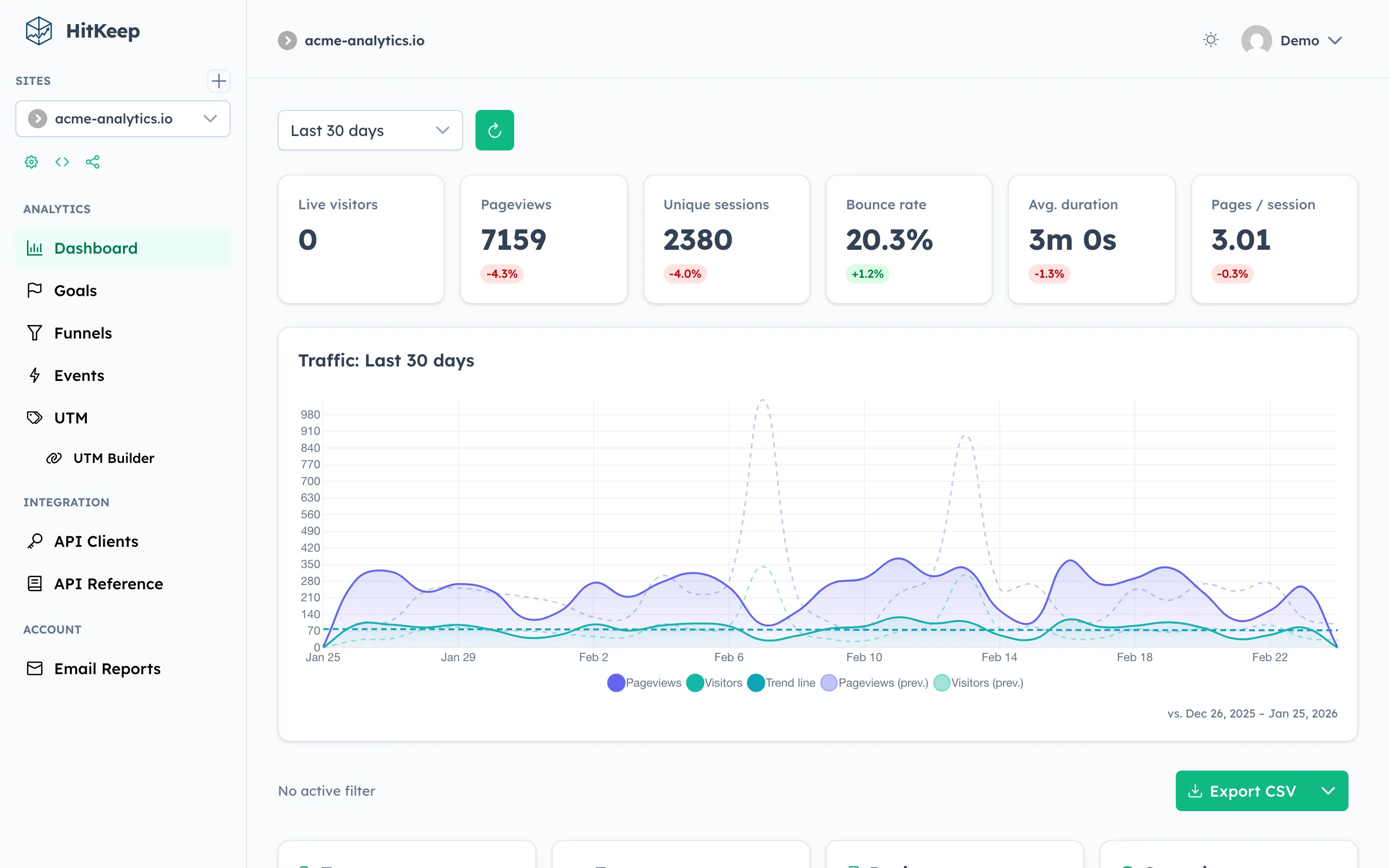
Most self-hosted analytics tools require you to manage a complex stack: a database server, a caching layer, a reverse proxy, and the application server.
HitKeep gives you that back.
It occupies the gap between simple log analyzers (GoAccess) and enterprise analytics stacks (Umami, Plausible) — without the operational complexity of either.
The Core Principles
Section titled “The Core Principles”1. Data Sovereignty
Section titled “1. Data Sovereignty”Your data lives in hitkeep.db on your server. No third party ever touches it. Configure retention per site. Export everything — any time, in open formats (JSON, CSV, Parquet). There is no lock-in.
2. Low Infrastructure Cost
Section titled “2. Low Infrastructure Cost”HitKeep idles at ~45–64 MB RAM and consumes negligible CPU between requests. A single $6/month VPS comfortably handles multiple sites. Compare that to a typical self-hosted analytics stack that requires dedicated compute for a database server, a queue broker, and the application itself — each sized for peak load.
Running analytics on AWS, GCP, or Hetzner? Because HitKeep is one process, you size one instance. There is no separate database node to keep warm, no managed cache to pay for by the hour, and no egress charges for cross-service traffic. For teams running analytics on cloud infrastructure, this routinely cuts the analytics line item from double digits per month to single digits.
3. The “Single Binary” Philosophy
Section titled “3. The “Single Binary” Philosophy”We believe self-hosting should be as simple as running a single command.
- Ingestion: Requests hit the Go HTTP server.
- Buffering: Events are published to an embedded NSQ topic in memory. This decouples the API from the database write speed.
- Storage: An internal consumer writes to embedded DuckDB, a high-performance OLAP database.
Everything is compiled into one file — the database, the queue, and the HTTP server.
What’s Included
Section titled “What’s Included”Analytics
Section titled “Analytics”- Pageview tracking with a 2 KB cookie-less snippet
- Traffic breakdown by country, device, browser, OS, and referrer
- Goals — path-based and event-based conversion tracking
- Funnels — multi-step conversion paths with drop-off analysis
- UTM parameter attribution, automatically captured
- Custom events from browser or server-side
Privacy & Compliance
Section titled “Privacy & Compliance”- Cookie-less by default — no consent banner required
- Respects Do Not Track (DNT) headers
- All data stored locally in
hitkeep.db— no third-party transfers - Configurable data retention per site
- Data takeout in JSON, CSV, or Parquet (GDPR Article 20)
Security
Section titled “Security”- Two-factor authentication — TOTP (authenticator apps) and Passkeys (WebAuthn / hardware keys)
- HTTP-only JWT cookies with configurable expiry
- Strict rate limiting on auth, API, and ingest endpoints
- IP exclusions to filter your own traffic and known bots
Access Control
Section titled “Access Control”- Instance-level roles (Owner, Admin, Member)
- Per-site permissions (Owner, Admin, Editor, Viewer)
- API clients with bearer tokens for programmatic access
- Shareable read-only dashboards for stakeholders
Operations
Section titled “Operations”- Email reports — scheduled digests and per-site summaries
- Multi-node clustering via Memberlist (gossip protocol)
- Health and readiness probes for orchestrators
- Built-in OpenAPI documentation at
/api/docs/v1
Cost Efficiency
Section titled “Cost Efficiency”- ~45–64 MB RAM at idle — runs alongside other workloads on a shared server
- Single process means one instance to size, monitor, and pay for
- No cross-service egress, no managed database node, no standby replicas
- Fits comfortably on a $6/month VPS for multi-site deployments
Localization
Section titled “Localization”- Dashboard UI fully translated into English, German, Spanish, French, and Italian
- Language preference stored server-side — follows you across devices
- Instant language switching without a page reload
- Community contributions welcome — add your language
Next Steps
Section titled “Next Steps”About the Author
Section titled “About the Author”HitKeep is built and maintained by Pascale Beier.
- Website: pascalebeier.de
- Email: mail@pascalebeier.de
Feel free to reach out for consulting, support, or just to say hi!