Skip to content
Start in Cloud

New HitKeep 2.7 is out. Read the release notes

Web analytics you own. Not the other way around.

HitKeep is open-source, self-hosted web analytics that shows you visitors, conversions, and the traffic AI sends or takes away, all in one clean dashboard. No cookies by default, nothing shared with ad networks. Start in our EU or US cloud, or run it on your own server.

Free plan · No credit card required · EU or US data region

5 minfrom signup to your first live dashboard
0cookies set by default, so your visitors stay anonymous
EU / USyour data stays in the region you choose
MITfully open source, with nothing hidden and no lock-in

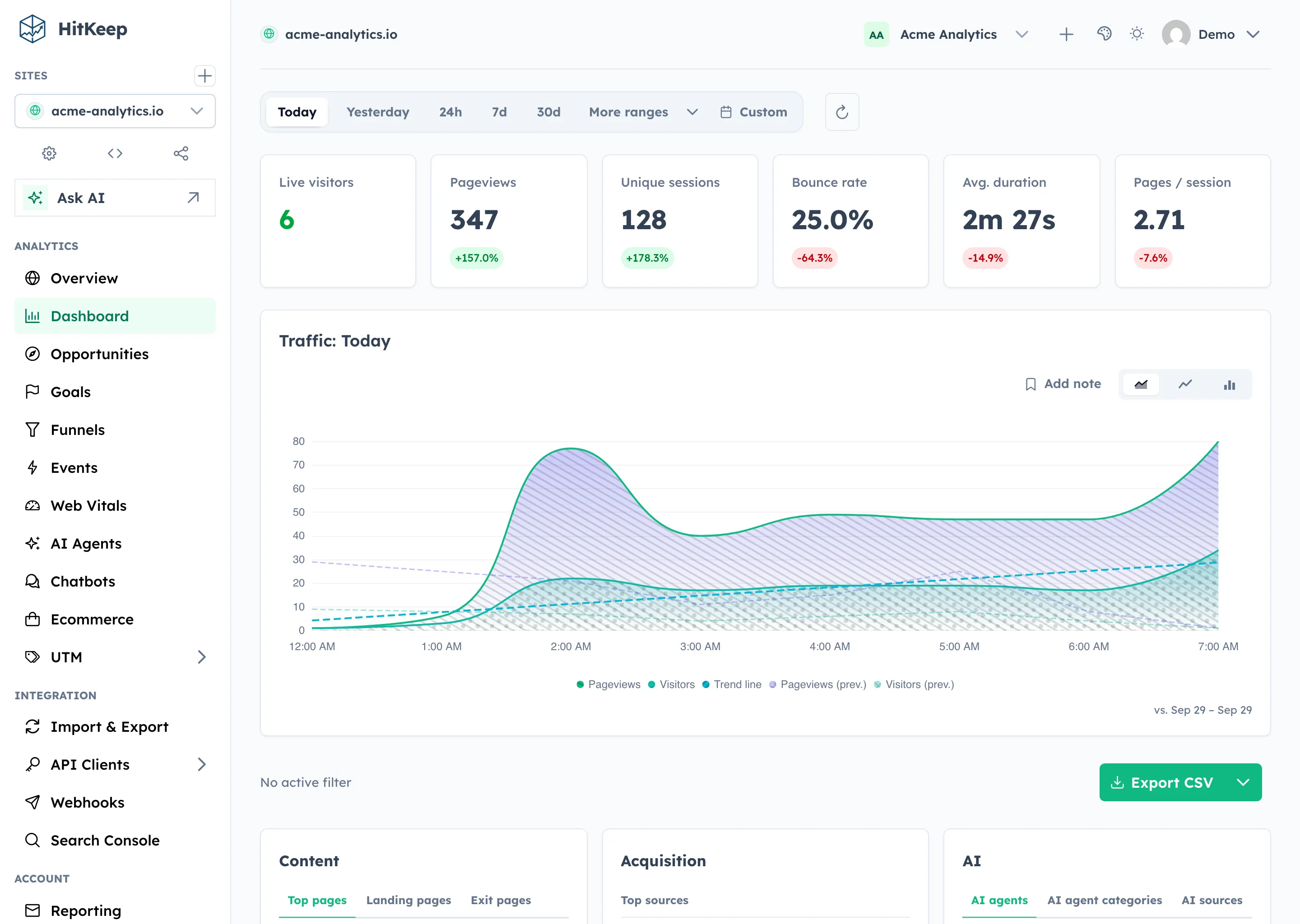
This is the real product embedded live, not a screenshot. Click around and explore traffic, conversions, AI visibility, and search queries, all in one place.

One product. Two ways to run it.

HitKeep Cloud and self-hosted HitKeep are the same product with the same dashboards. The only difference is who does the maintenance.

Self-Hosted

One binary on your hardware. Your data sits in a DuckDB file you can back up with cp.

  • Linux binaries for amd64 and arm64, no container required
  • No telemetry, no phone-home, runs air-gapped
  • Full feature set, because security is not an upsell
  • Everything configurable via flags or environment variables
Read the install guide

Open exports in JSON, CSV, and Parquet mean you can move between the two later, in either direction.

Everything you came for. Nothing to babysit.

Conversions, not just pageviews

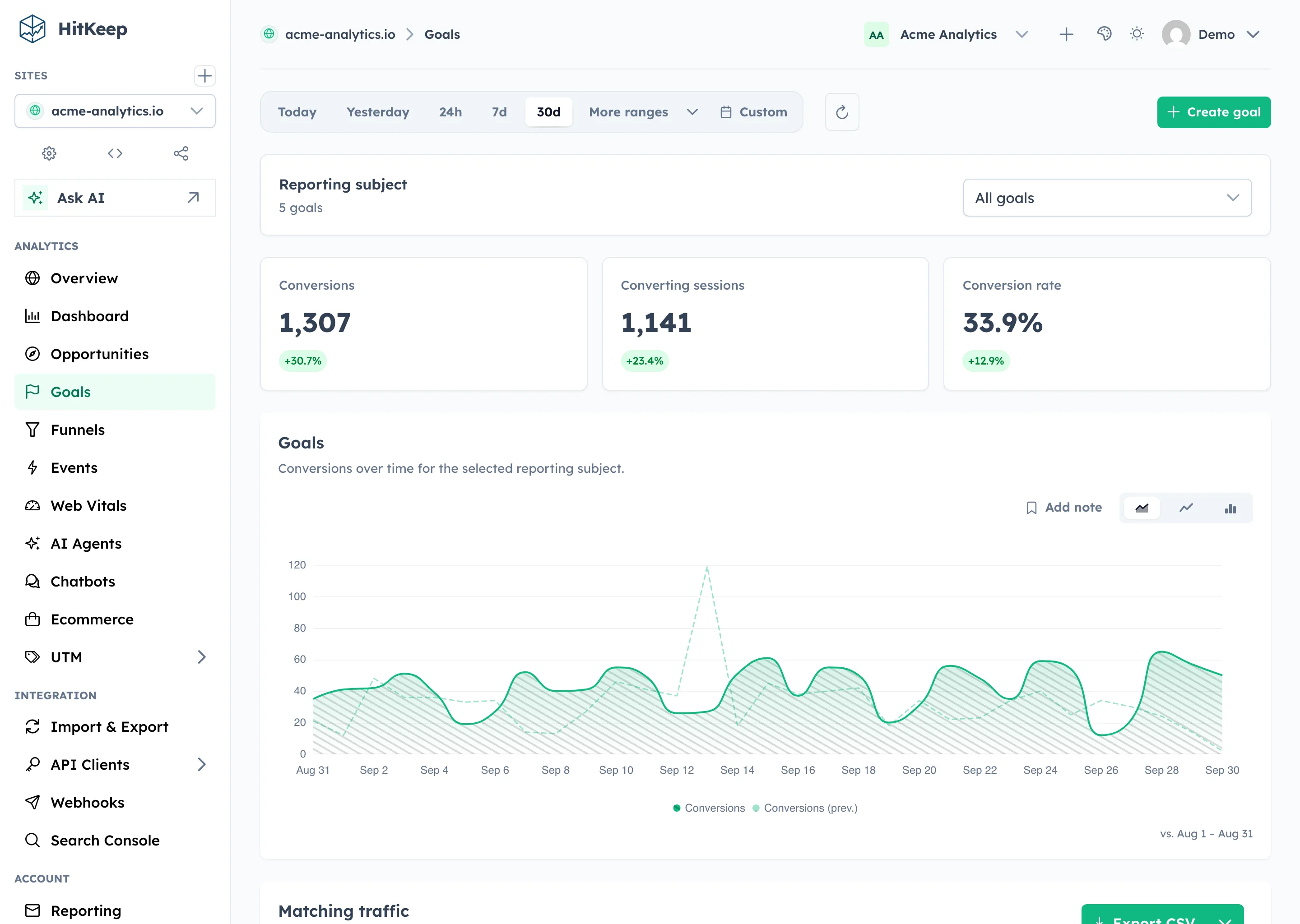
Goals, multi-step funnels, ecommerce revenue, and UTM attribution live in the same dashboard as your traffic. No tag manager, no second event pipeline, no per-event pricing.

Ecommerce and conversion analytics
HitKeep goals and conversion tracking dashboard

See what AI sends you, and what it takes away

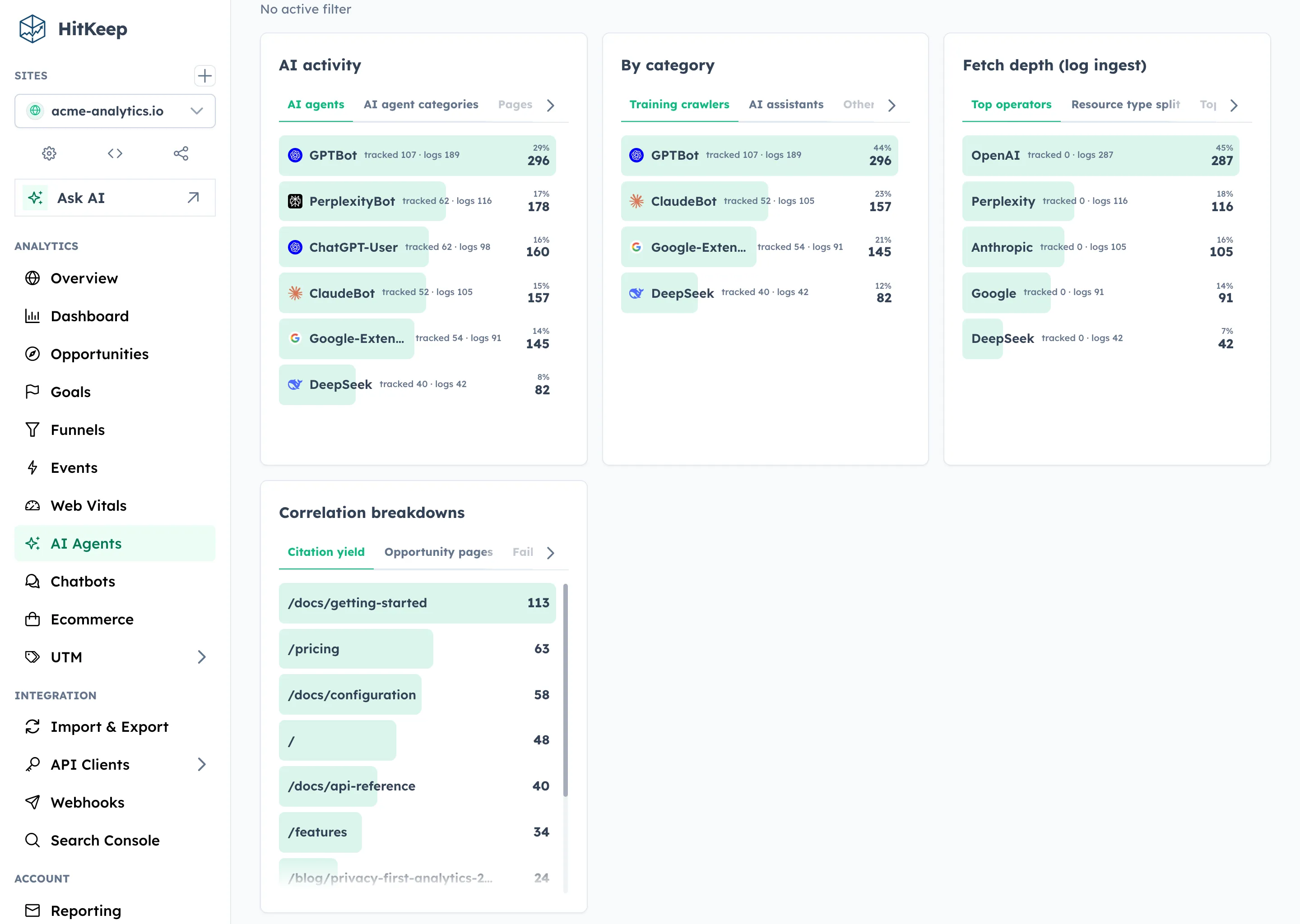
HitKeep tracks AI crawler fetches and AI-referred visits next to your regular traffic, and imports Google Search Console query data so search and AI discovery sit side by side.

How AI Overviews change your traffic
HitKeep AI visibility analytics with fetch KPI cards, filters, and fetch volume chart

Reporting that runs itself

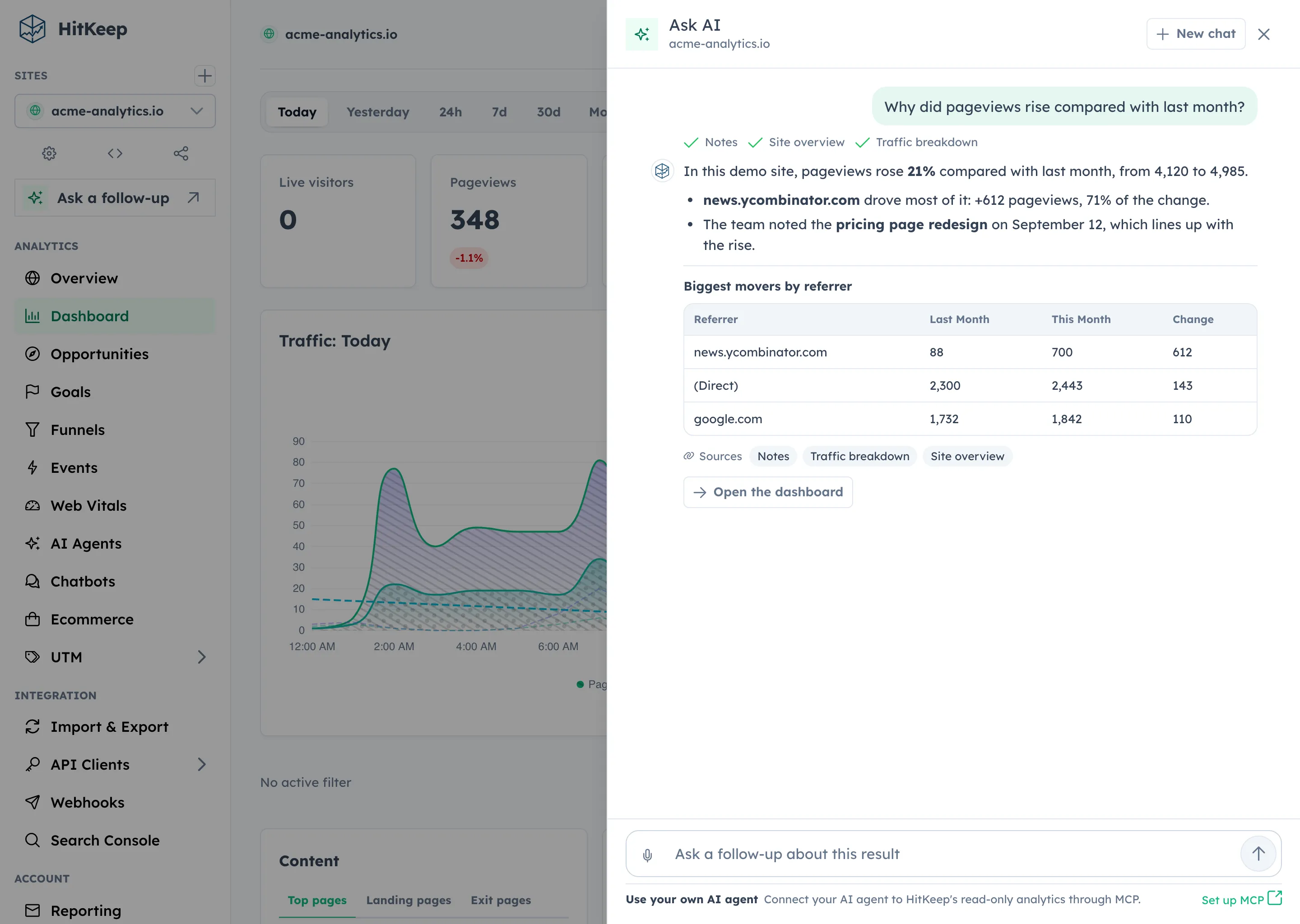
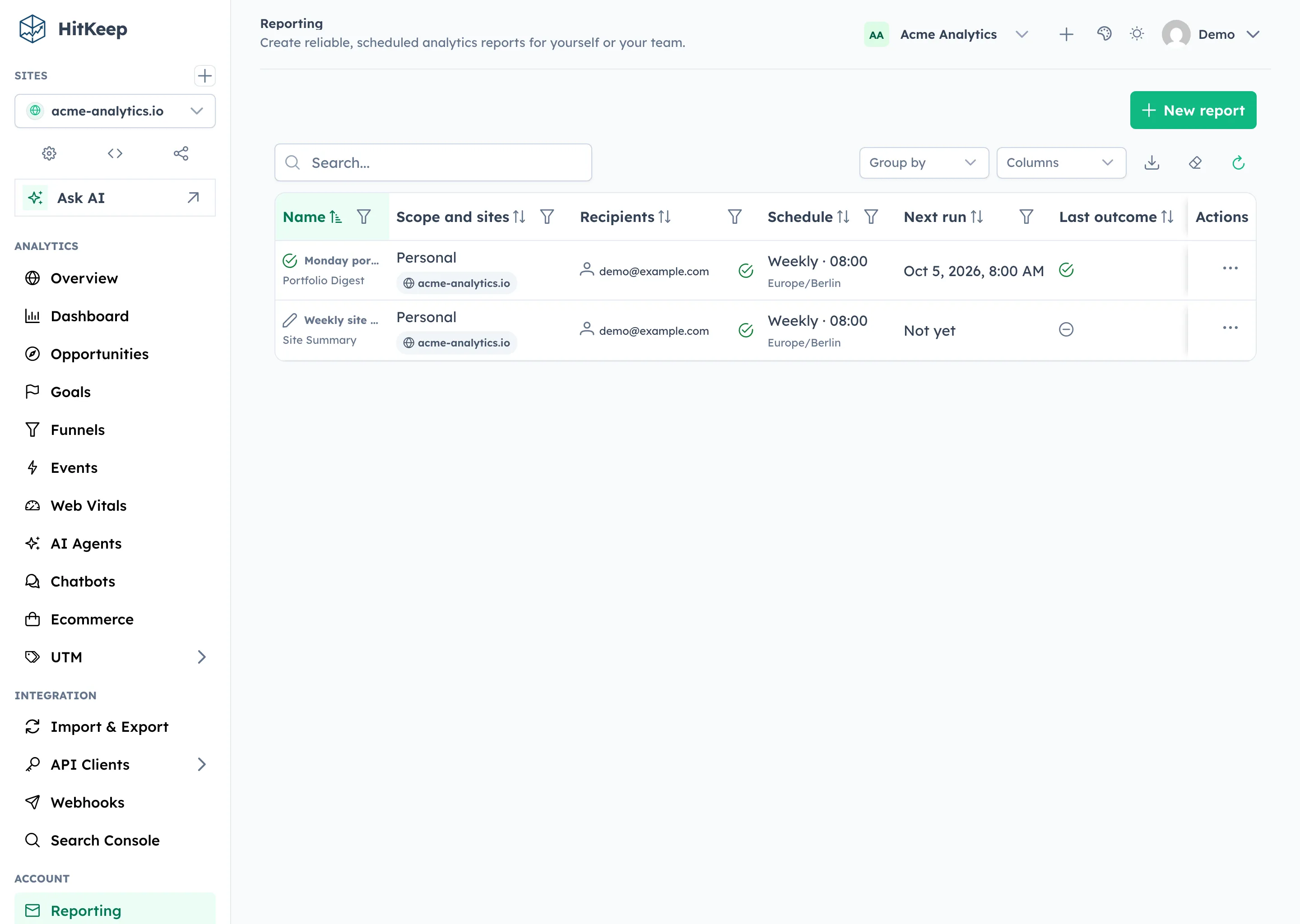
Scheduled email digests, shareable read-only dashboards, a REST API, and a governed read-only MCP server for approved assistants, all behind the same site and team permissions.

Analytics access for AI assistants
HitKeep email reports with weekly digest and per-site notifications

Automatic events

hk.js records outbound clicks, file downloads, and form submissions out of the box, without ever storing form contents. Cookieless event tracking

Cookie-free by default

Default tracking sets no cookies and avoids personal identifiers, keeping privacy-first analytics simple to implement. Privacy-first analytics

WebAuthn, passkeys, 2FA

Hardware-key login, role-based access, team isolation, and audit logs ship in the core product, on every plan and every deployment.

Open exports

Your full analytics history exports to JSON, CSV, or Parquet whenever you want it. Migrate, audit, or archive without asking permission.

Read-only MCP

Scoped tokens give approved assistants aggregate answers about traffic, events, and conversions, never write access. MCP analytics access

WordPress and REST API

A first-party WordPress plugin and a documented REST API cover the common integration paths. WordPress analytics

Zero to first pageview in three commands.

No database to provision, no queue to configure, no docker-compose file to maintain. The architecture really is this small.

01
Download

One Linux binary for amd64 and arm64. No runtime, no package manager, no container required.

curl -L .../hitkeep-linux-amd64 -o hitkeep && chmod +x hitkeep
02
Configure

Two flags get you to production. The configuration reference covers the rest. DuckDB and NSQ are already embedded.

./hitkeep -public-url="https://analytics.example.com" -jwt-secret="..."
03
Track

Add the snippet. Pageviews, outbound clicks, downloads, and form submissions start flowing immediately.

<script async src="https://analytics.example.com/hk.js"></script>

Built for teams that answer to a DPO.

Cookie-free by default

Default tracking avoids cookies and unnecessary personal identifiers, reducing the implementation overhead of privacy-first analytics.

Zero telemetry

The server process never phones home. Traffic data, accounts, and reports stay under your control unless you export them.

Data sovereignty

Self-host on your own infrastructure, or pin your Cloud region to the EU. HitKeep is built with the GDPR in mind, and the trade-offs are documented.

Open source, auditable

The full codebase is MIT licensed, so procurement, security, and engineering can read exactly what runs in production.

Pricing you can read in ten seconds.

Every plan includes the full product: goals, funnels, automatic events, Search Console import, email reports, and API access. Plans differ on retention and limits, not features.

Free

€0 forever

  • 3 sites · 3 team members
  • 60-day retention
  • Full feature set
Start on Free

Self-hosting is free, forever. HitKeep is MIT-licensed software, not a trial.

Frequently asked questions

Is HitKeep a self-hosted alternative to Google Analytics?

Yes. HitKeep covers pageviews, events, goals, funnels, ecommerce, and UTM attribution without cookies or third-party data sharing, and it imports Google Search Console data so query-level search reporting moves with you. The difference is operational: one binary instead of a hosted suite, with your data in a DuckDB file you own. See the self-hosted GA4 alternative guide.

Can HitKeep run on a 512 MB VPS or a Raspberry Pi?

Yes. HitKeep ships as one static Go binary with DuckDB and NSQ embedded, so there is no database server or queue competing for memory. Linux builds are available for amd64 and arm64, which covers most VPS providers and the Raspberry Pi. The installation guide takes about five minutes.

Does cookie-less tracking remove the need for a consent banner?

Default tracking sets no cookies and avoids personal identifiers, which removes the most common trigger for consent banners. Whether your specific configuration requires one is a legal assessment only your team can make. HitKeep documents exactly what it stores so that assessment is straightforward. More in privacy-first web analytics.

How is HitKeep different from Plausible, Umami, or Matomo?

Mostly in what you have to operate. Plausible runs on ClickHouse and Postgres, Umami needs Postgres or MySQL, and Matomo needs MySQL and PHP. HitKeep embeds its database (DuckDB) and queue (NSQ) in a single binary, so self-hosting means running one process. Importers for Plausible and Simple Analytics are built in if you are migrating.

Where does HitKeep Cloud store my data?

You pick the region at signup, EU or US, and your data stays pinned there, including backups. If you ever want to leave, your full history exports to JSON, CSV, or Parquet. Details on EU and US cloud analytics.

Why DuckDB instead of ClickHouse or Postgres?

DuckDB is an embedded analytical database: column-oriented query speed without a separate server process. For the data volumes most sites produce, it answers dashboard queries in milliseconds while keeping the deployment a single file on disk you can back up with cp.

Ready to own your analytics?

Create a free Cloud account in a pinned EU or US region, or download one binary and self-host tonight.

View the source on GitHub