If you are comparing HitKeep and Clamp, the real question is not “which tool has the longest feature list?”
The real question is: who should own the analytics workflow?
Clamp is built around an AI coding agent that queries, diagnoses, and changes analytics setup from chat. HitKeep is built around dashboards, reports, exports, and permissions that teams use directly, with optional read-only MCP access for approved assistants and internal tools.
Choose HitKeep if you want self-hosted or managed EU/US analytics with MIT-licensed source, a single-binary runtime, embedded DuckDB and NSQ, dashboard-first reporting, read-only MCP for approved assistants, open exports, AI visibility analytics, chatbot analytics, ecommerce reports, Search Console aggregates, goals, funnels, automatic events, scheduled reports, and admin/security controls.
Choose Clamp if you want a SaaS analytics product whose main workflow happens in Claude Code, Cursor, Windsurf, or another MCP client, and you need published agent skills, agent-created funnels and alerts, cohort retention, A/B test analysis, error tracking, user journeys, live visitors, and alert workflows.
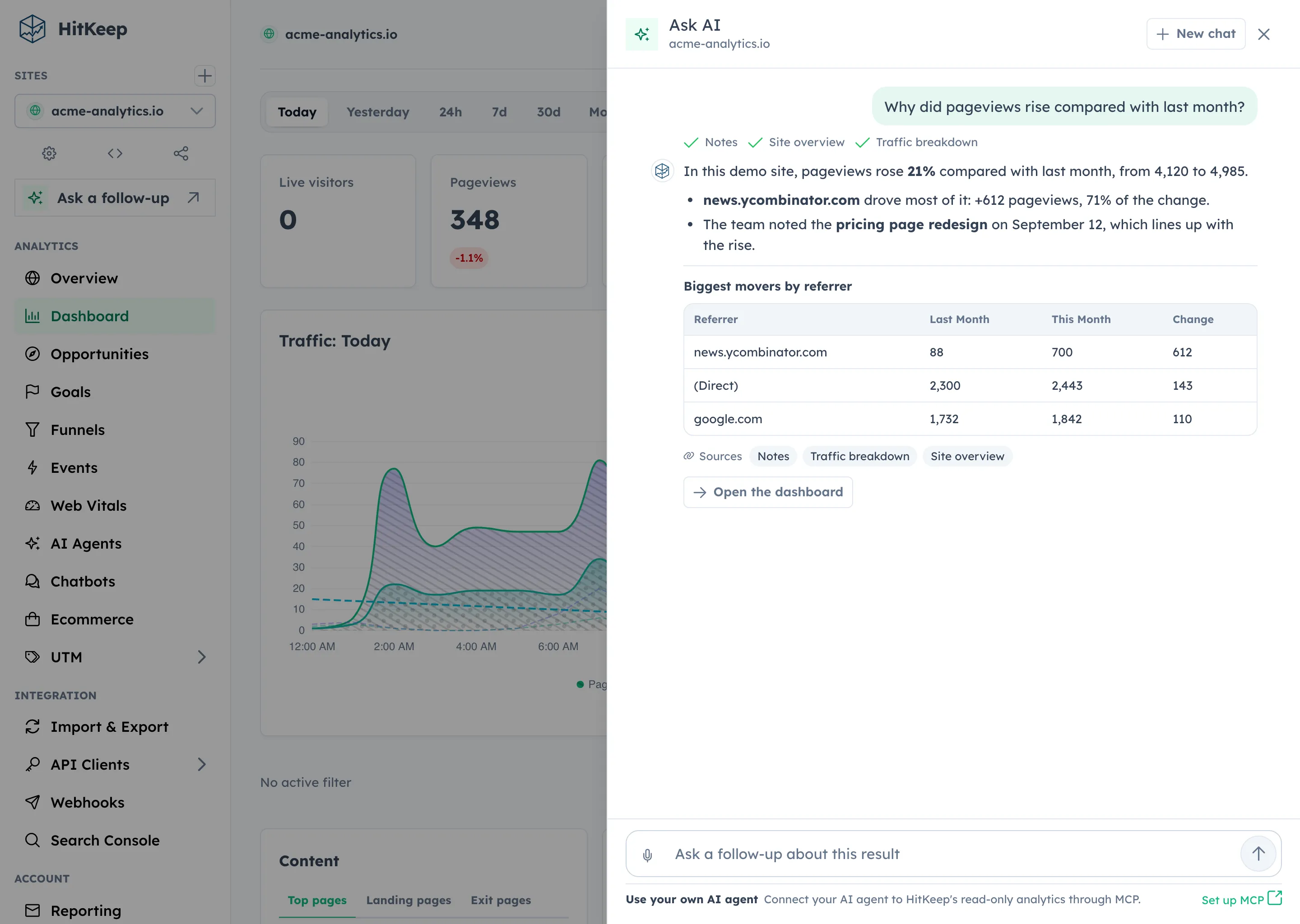
Ask AI keeps the human dashboard visible: tool calls, citations, result data, and safe navigation actions remain inspectable in the active site context.
Clamp Alternative With Dashboards, Self-Hosting, And Read-Only MCP
HitKeep belongs on the shortlist when the search is narrower than “Clamp alternative”:
dashboard-first sovereign analytics with optional read-only MCP access for approved assistants
a self-hosted or managed EU/US analytics product with dashboards, roles, exports, and admin controls
governed MCP analytics access where assistants can query approved aggregate analytics but cannot write product state
website and product reporting through goals, funnels, ecommerce analytics, Search Console aggregates, AI visibility, chatbot analytics, and scheduled reports
a product boundary that keeps dashboard, REST API, MCP, exports, teams, and permissions together
The important difference is control. HitKeep keeps dashboard, REST API, MCP, exports, teams, and permissions inside one product boundary. The MCP route is intentionally read-only and aggregate-only.
Signed operational webhooks give HitKeep a deterministic server-to-server path for site, goal, import, team, and user changes. That path is separate from both Ask AI and read-only MCP, which matters when an automation must not depend on an agent interpreting analytics data.
Clamp is a hosted analytics product. Its public pages describe EU-hosted infrastructure and a remote MCP setup scoped to a project.
HitKeep can run as:
self-hosted OSS
managed cloud in EU Frankfurt
managed cloud in US Virginia
The self-hosted runtime is one Go binary with embedded DuckDB and NSQ. No PostgreSQL, ClickHouse, Redis, Kafka, or external queue is required for core analytics. That matters when the analytics tool itself must pass infrastructure, procurement, or network review.
Clamp’s strongest message is that you do not need dashboards or query builders. That is a good fit for teams that want the agent to be the main analytics interface.
HitKeep keeps the dashboard as the primary operating surface:
compact overview reporting
events, goals, funnels, ecommerce, UTM, AI visibility, and chatbot pages
shareable dashboards
scheduled email reports
admin status, teams, roles, API clients, and exports
MCP adds assistant access to that product. It does not replace the product.
HitKeep MCP uses API client bearer tokens. Tokens can be personal or team-owned, scoped to specific sites, and revoked through the same API client lifecycle as other integrations.
The MCP server is read-only:
list visible sites
return aggregate overview analytics
inspect events and property breakdowns
query ecommerce summaries
query AI visibility analytics
fetch official docs as markdown
It does not create funnels, create alerts, mutate goals, expose raw hit exports, manage sites, touch billing, or perform instance administration.
That is intentionally narrower than Clamp. It is also easier to explain to security reviewers.
4. AI visibility is a first-class analytics surface
HitKeep includes open exports and takeout so teams can move, audit, archive, or analyze their data outside HitKeep.
Managed cloud removes operating work. It does not make the data model opaque. Self-hosting keeps the database files and export paths under your control.
Clamp’s public pages are centered on Claude Code, Cursor, Windsurf, OpenAI, Copilot, and MCP clients. The documented workflow is: ask in chat, have the agent query analytics, diagnose the change, and then ship or monitor the fix.
If your team wants analytics to live primarily in the coding agent, Clamp is ahead of HitKeep’s current MCP surface.
Clamp documents MCP tools for traffic overview, time series, comparisons, live visitors, breakdowns, page engagement, events, observed event schema, revenue, paths, user journeys, funnels, cohorts, errors, and alerts.
HitKeep MCP is narrower by design. It covers aggregate site overview, event names and breakdowns, ecommerce, AI visibility, imported Search Console reports, docs, and help resources.
Clamp documents six model-invoked analytics skills that teach an agent how to diagnose traffic changes, judge channel quality, read metrics in context, author event schemas, and avoid common funnel mistakes.
HitKeep does not currently publish an equivalent analytics-skills package.
4. Clamp covers retention, experiments, errors, and alerts
Self-hosted single Linux binary or managed EU/US cloud
External services
Embedded DuckDB and NSQ; no PostgreSQL, Redis, Kafka, ClickHouse, separate queue, cache, or database service for core analytics
Binary size and memory
Current Linux release binaries are about 100 MB; recent HitKeep Cloud checks showed about 205-769 MiB of memory use
Storage and backups
DuckDB files live under the configured data directory; multiteam deployments include tenants/*/hitkeep.db
Privacy behavior
hk.js sets no analytics cookies, uses sessionStorage for session continuity, and respects DNT unless configured otherwise
Custom tracking domains
Team admins can verify multiple tracker hostnames; active team domains serve hk.js, hk-vitals.js, and browser ingest for every site in that team. Site Settings can generate snippets from the instance URL or any active team domain.
Automatic events
outbound_click, file_download, and form_submit
Exports and non-replacements
JSON, CSV, Parquet, NDJSON, and XLSX where supported; HitKeep does not replace enterprise attribution, CMP, SIEM, CRM, warehouse, feature flag, or experimentation workflows
your analytics workflow should live mainly inside Claude Code, Cursor, or another MCP client
agent-created funnels, alerts, and diagnostics are the buying reason
cohorts, retention, A/B tests, errors, live visitors, and user journeys matter more than self-hosting
a hosted SaaS product with OAuth MCP setup is easier for your team than operating or governing your own instance
Frequently Asked Questions
Is HitKeep a good alternative to Clamp?
Yes, if the real requirement is sovereign web analytics with optional AI assistant access. HitKeep is stronger on self-hosting, EU / US region choice, open source auditability, dashboards, exports, admin controls, and read-only governed MCP. Clamp is stronger when the agent is meant to be the primary analytics interface.
Does HitKeep have an analytics MCP server?
Yes. HitKeep includes an optional analytics MCP server for AI assistant analytics access from tools that support Streamable HTTP MCP. Claude, Cursor, and other MCP clients can query approved aggregate analytics when configured with a scoped API client token.
Does HitKeep MCP let an agent create funnels or alerts?
No. HitKeep MCP is read-only. It does not create funnels, alerts, goals, sites, billing changes, or admin actions. Use the dashboard and REST API for normal product workflows.
What does Clamp have that HitKeep does not?
Clamp documents agent skills, write-capable MCP workflows, OAuth remote MCP setup, cohorts and retention, A/B test analysis, error tracking, user journeys, live visitors, and alerts. HitKeep does not currently match those workflows.
Can I use HitKeep Cloud instead of self-hosting?
Yes. HitKeep Cloud gives you the same core analytics product in managed EU or US regions. Use it when you want the HitKeep ownership model without running updates, backups, SMTP, and day-two operations yourself.