
HitKeep vs Offen: Operator vs Consent-First Analytics
Section titled “HitKeep vs Offen: Operator vs Consent-First Analytics”If you are comparing HitKeep vs Offen, the first thing to know is that these products optimize for different outcomes.
- Offen is built around explicit consent, first-party cookies, and a strong user self-service story where visitors can access or delete their own data.
- HitKeep is built around operator clarity: self-hosted or managed cloud analytics, goals, funnels, exports, and dedicated reporting for AI visibility and AI chatbot performance.
That means HitKeep is not trying to replace Offen’s “fair analytics” philosophy one-for-one.
It is a better fit when the actual business question is:
“Is AI discovery, AI traffic, or our own AI assistant creating useful demand?”
Best Fit
Section titled “Best Fit”Choose HitKeep if your priority is operator-owned analytics: goals, funnels, automatic events, Search Console aggregates, AI visibility, chatbot analytics, team workflows, and managed cloud or self-hosting.
Choose Offen if your priority is consent-first fair analytics with end-user data access, deletion, and a product philosophy centered on visitor agency.
Fast validation path: start in HitKeep Cloud, keep Offen where explicit opt-in analytics matters, and evaluate HitKeep for internal reporting and conversion workflows. Operator path: use the self-hosted installation guide when you want the data plane on your own infrastructure.
Offen Alternative For Operator Analytics And AI Reporting
Section titled “Offen Alternative For Operator Analytics And AI Reporting”HitKeep belongs on the shortlist when the search is narrower than “Offen alternative”:
- an Offen alternative for operator-owned analytics with goals, funnels, ecommerce reports, and managed cloud
- an AI visibility and AI chatbot analytics product for teams measuring AI discovery, referrals, and assistant-assisted outcomes
- a WordPress analytics product with automatic outbound click, file download, and form tracking
- a privacy-conscious reporting surface with Search Console aggregates and read-only MCP reporting
- a self-hosted or managed EU/US analytics product when visitor self-service data access is less important than internal reporting
Quick-Scan Feature Matrix
Section titled “Quick-Scan Feature Matrix”| Feature | HitKeep | Offen |
|---|---|---|
| Self-hosted | Single binary (about 100 MB), zero external services | Single binary or Docker, relational datastore required |
| Managed cloud | EU / US | Not publicly documented |
| Team OIDC SSO | Business on Cloud; included self-hosted | Not publicly documented |
| Google, GitHub, and Microsoft social sign-in | Yes | Not publicly documented |
| External dependencies | None (embedded DuckDB + NSQ) | SQLite by default, MySQL / Postgres optional |
| Cloud memory | About 205-769 MiB in recent HitKeep Cloud checks | 512 MB for small setups |
| Consent model | Cookie-less by default | Explicit opt-in only |
| Browser identity model | sessionStorage for session continuity | First-party cookie after consent |
| End-user self-service data access | No dedicated end-user portal | Yes |
| AI visibility analytics | Yes | Not documented |
| On-site AI chatbot analytics | Yes | Not documented |
| Goals | Yes | Not documented |
Automatic events (outbound_click, file_download, form_submit) | Yes | Not documented |
| Web Vitals analytics | Yes, opt-in | Not documented |
| First-party WordPress plugin | Yes | Vendor-specific |
| Funnels | Yes | Not documented |
| Chart annotations | Yes, from 2.14.0 | Not documented |
| Ecommerce reporting | Yes | Not documented |
| QR campaigns | Yes | Not publicly documented |
| UTM campaign / source reporting | Yes | Yes |
| Google Search Console Search Analytics import | Yes, aggregate rows only | Not documented |
| Landing pages / exit pages | Yes | Yes |
| Data retention | Configurable per site | Docs describe 6-month retention |
| Managed region choice | EU / US | Not documented |
| Localization | 7 UI languages (EN, DE, ES, FR, IT, NL, PT) | 6 documented languages |
| Read-only MCP analytics server | Optional read-only MCP over API client tokens | Not documented |
Quick Answer
Section titled “Quick Answer”HitKeep is the better Offen alternative if you want:
- dedicated reporting for AI visibility
- AI chatbot analytics and assisted conversions
- goals, funnels, and focused ecommerce reporting
- managed cloud with explicit EU or US region choice
- a single-binary deployment story with no external database or queue
Offen is better if you want:
- explicit opt-in analytics as the core product model
- end-user access, deletion, and opt-out as a first-class feature
- a product that treats operators and website users as equal first-class audiences
- a fair-analytics posture where user agency matters more than maximum data capture
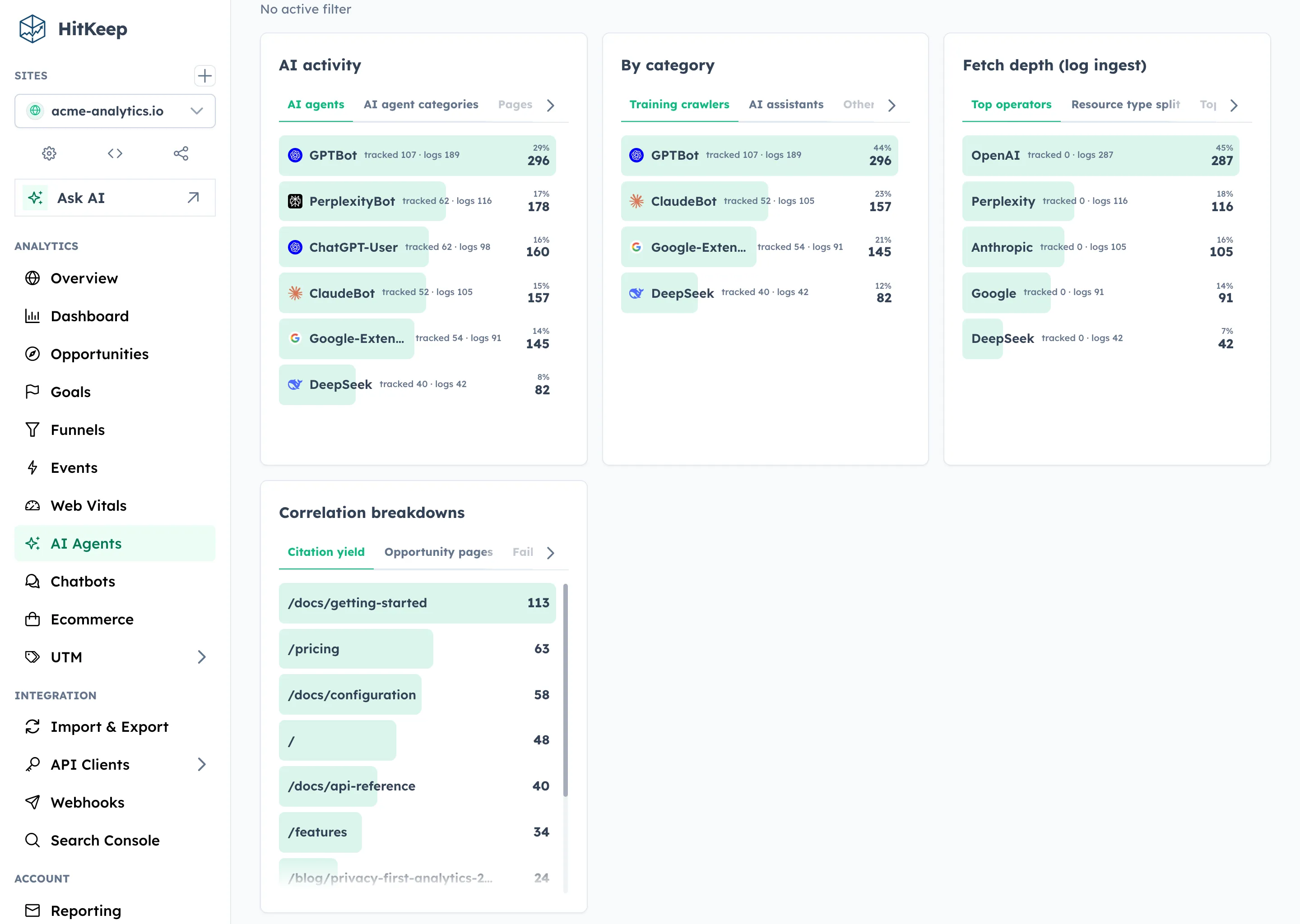
That is the core split.
Offen helps you do analytics in a consent-first, user-visible way. HitKeep helps you answer whether AI systems are discovering your content and whether that visibility creates real traffic or conversions.
Why Teams Look for an Offen Alternative
Section titled “Why Teams Look for an Offen Alternative”Teams evaluating Offen usually want at least one of these:
- more operator-oriented analytics depth
- conversion tracking beyond pageview and referral reporting
- managed hosting instead of only self-hosting
- clearer reporting around AI discovery, AI traffic, and AI assistants
That is where HitKeep has the clearest edge.
Where HitKeep Is Better
Section titled “Where HitKeep Is Better”HitKeep’s signed operational webhooks notify external systems about lifecycle events such as goal conversions or completed imports. They do not send raw visitor traffic, form contents, or AI crawler records, so the integration boundary stays narrower than an analytics data feed.
1. It answers the “is AI working?” question directly
Section titled “1. It answers the “is AI working?” question directly”This is the biggest difference.
HitKeep includes:
- AI visibility analytics for crawler fetches and fetch-to-visit correlation
- AI chatbot analytics for prompts, responses, citations, handoffs, and assisted conversions
- goals and funnels to connect AI-origin traffic to actual outcomes
The Offen docs do not describe any dedicated AI visibility or AI assistant reporting surface.
If your commercial question is:
“Did ChatGPT or our own AI assistant create value?”
HitKeep is much closer to the answer out of the box.
2. The operator story is simpler
Section titled “2. The operator story is simpler”Offen is still comparatively lightweight, but its current docs describe a different operating model:
- SQLite by default, with MySQL or Postgres when scaling
- same-domain / subdomain requirements for first-party cookie behavior
- explicit CSP and iframe considerations
- consent banner setup as part of the normal deployment story
HitKeep’s value proposition is more direct for infrastructure teams:
- one static Go binary
- embedded DuckDB
- embedded NSQ
- no external database dependency
That matters if your requirement is not just “open source analytics” but “analytics without another stack to run.”
3. Managed cloud exists today
Section titled “3. Managed cloud exists today”HitKeep already offers managed cloud in:
- EU (Frankfurt)
- US (Virginia)
That is useful if you want to prove value quickly, win early customers, or avoid turning analytics into an internal platform project.
Offen’s official website and docs focus on self-hosted deployment. They do not document a managed cloud offering.
4. HitKeep is stronger for internal reporting and team workflows
Section titled “4. HitKeep is stronger for internal reporting and team workflows”HitKeep already includes:
- shareable dashboards
- email reports
- roles and permissions
- API clients
- data takeout in JSON, CSV, Parquet, NDJSON, and XLSX where supported
That gives it a more operator-facing, reporting-heavy posture than Offen’s documented product surface.
5. Conversion reporting is broader
Section titled “5. Conversion reporting is broader”Offen’s docs clearly cover:
- pageviews and users
- referrers
- campaigns and sources
- landing pages and exit pages
- weekly retention
HitKeep goes further into conversion-oriented analytics:
- goals
- funnels
- focused ecommerce reporting
- assisted conversions for on-site AI assistants
If the decision is driven by revenue, pipeline, or client reporting, HitKeep is the more natural fit.
Where Offen Is Better
Section titled “Where Offen Is Better”1. End-user data access is a real differentiator
Section titled “1. End-user data access is a real differentiator”This is the strongest reason to choose Offen.
Offen is unusually serious about user rights in-product:
- users can access their own usage data
- users can delete it
- users can opt out at any time
HitKeep does not currently offer a dedicated end-user self-service data portal like that.
If your priority is making website visitors first-class participants in the analytics model, Offen has a real advantage.
2. Consent-first analytics is the actual product philosophy
Section titled “2. Consent-first analytics is the actual product philosophy”Offen’s public materials are explicit:
- data collection is opt-in only
- a consent banner is part of the normal flow
- unique users are identified by a first-party cookie set after opting in
HitKeep is built from a different starting point. It aims for privacy-first analytics with cookie-less default tracking, but it is not a consent-first fair-analytics product in Offen’s sense.
3. The fairness and transparency narrative is more distinctive
Section titled “3. The fairness and transparency narrative is more distinctive”Offen’s positioning is unusually crisp:
- operators and users are both target audiences
- users get visibility and control
- analytics is framed as something that should be ethically legible
That is a distinctive product philosophy, not just a feature checklist.
If that philosophy is the primary reason you are buying, Offen remains the stronger fit.
HitKeep Technical Facts
Section titled “HitKeep Technical Facts”| Check | HitKeep fact |
|---|---|
| Deployment model | Self-hosted single Linux binary or managed EU/US cloud |
| External services | Embedded DuckDB and NSQ; no PostgreSQL, Redis, Kafka, ClickHouse, separate queue, cache, or database service for core analytics |
| Binary size and memory | Current Linux release binaries are about 100 MB; recent HitKeep Cloud checks showed about 205-769 MiB of memory use |
| Storage and backups | DuckDB files live under the configured data directory; multiteam deployments include tenants/*/hitkeep.db |
| Privacy behavior | hk.js sets no analytics cookies, uses sessionStorage for session continuity, and respects DNT unless configured otherwise |
| Custom tracking domains | Team admins can verify multiple tracker hostnames; active team domains serve hk.js, hk-vitals.js, and browser ingest for every site in that team. Site Settings can generate snippets from the instance URL or any active team domain. |
| Automatic events | outbound_click, file_download, and form_submit |
| Exports and non-replacements | JSON, CSV, Parquet, NDJSON, and XLSX where supported; HitKeep does not replace consent portals, CMPs, SIEM, CRM, warehouse, feature flag, or experimentation workflows |
What HitKeep Still Does Not Replace
Section titled “What HitKeep Still Does Not Replace”- the end-user self-service portal
- the explicit opt-in-only collection model
- the “fair analytics” product philosophy
- the tighter connection between consent, access, and deletion in one experience
When To Choose HitKeep Instead of Offen
Section titled “When To Choose HitKeep Instead of Offen”Choose HitKeep when:
- you want to measure AI visibility and AI-origin traffic
- you need to know whether your AI assistant is helping conversions
- you want self-hosting or managed cloud
- you need goals, funnels, exports, and more operator-centric analytics depth
- you want one binary with no external database dependency
When To Choose Offen Instead of HitKeep
Section titled “When To Choose Offen Instead of HitKeep”Choose Offen when:
- you want explicit opt-in analytics by design
- user access, deletion, and opt-out are central requirements
- you prefer a fair-analytics product philosophy over broader reporting scope
- AI visibility and conversion reporting are less important than user agency
Migration Notes
Section titled “Migration Notes”HitKeep and Offen can coexist because they answer different questions. Keep Offen where explicit consent-first analytics is the product requirement, and test HitKeep for operator reporting, goals, funnels, automatic events, and AI visibility.
Use HitKeep Cloud when you want a quick reporting pilot. Use self-hosted HitKeep when you want the same operator analytics surface on controlled infrastructure.
Frequently Asked Questions
Section titled “Frequently Asked Questions”Is HitKeep a good alternative to Offen?
Section titled “Is HitKeep a good alternative to Offen?”Yes, if you need AI visibility, chatbot analytics, goals, funnels, or managed cloud. Offen is stronger if you specifically want consent-first fair analytics with end-user self-service access and deletion.
Does Offen track AI visibility or AI chatbot performance?
Section titled “Does Offen track AI visibility or AI chatbot performance?”Not in the Offen documentation. HitKeep adds dedicated AI visibility analytics, AI chatbot analytics, and assisted-conversion reporting.
Does Offen require consent?
Section titled “Does Offen require consent?”Yes. Offen’s public docs describe an explicit opt-in model and identify unique users using a first-party cookie set after consent is given.
Can I use HitKeep without self-hosting?
Section titled “Can I use HitKeep without self-hosting?”Yes. HitKeep is available as a single binary for self-hosting and as managed cloud in EU or US regions.
Can I try HitKeep Cloud before replacing Offen?
Section titled “Can I try HitKeep Cloud before replacing Offen?”Yes. Start with one site in HitKeep Cloud, keep Offen for consent-first analytics, and evaluate whether HitKeep answers your operator reporting and conversion questions.
Sources
Section titled “Sources”- Offen home page
- Offen operator guide
- Offen requirements for installing
- Offen subdomain setup
- Offen embedding the script
- Offen consent banner docs
- Offen metrics explained
- Offen user data access