
Rybbit Alternative Without ClickHouse: HitKeep vs Rybbit
Section titled “Rybbit Alternative Without ClickHouse: HitKeep vs Rybbit”Rybbit is an open-source privacy-first analytics platform with session replay, funnels, and user journeys. Its current Docker Compose stack runs the client and backend with ClickHouse, PostgreSQL, and Redis; an optional Caddy profile terminates TLS.
HitKeep takes a different approach: one binary, zero dependencies. No ClickHouse, no Docker orchestration, no multi-service stack.
The real comparison is about what you want to carry operationally and whether you need session replay.
Best Fit
Section titled “Best Fit”Choose HitKeep if you want aggregate analytics without operating ClickHouse or making session replay part of the product’s privacy boundary, and the MIT license fits your organization.
Choose Rybbit if session replay, error tracking, user journeys, and its broader integration list are central requirements.
Fast validation path: start in HitKeep Cloud, track one site, and compare aggregate reporting before changing your self-hosting stack. Operator path: use the self-hosted installation guide when the goal is one binary and one data directory.
Rybbit Alternative Without ClickHouse
Section titled “Rybbit Alternative Without ClickHouse”HitKeep belongs on the shortlist when the search is narrower than “Rybbit alternative”:
- a Rybbit alternative without ClickHouse or Docker Compose, with an MIT-licensed codebase
- aggregate analytics for teams that do not need session replay, error tracking, or user journey playback
- a WordPress analytics product with automatic outbound click, file download, and form tracking
- a privacy-conscious reporting surface with Search Console aggregates, AI visibility analytics, AI chatbot analytics, and read-only MCP reporting
- managed EU or US cloud analytics with the same reporting and export model available to self-hosted deployments
Quick-Scan Feature Matrix
Compare HitKeep and Rybbit across hosting, analytics depth, governance, and operations.
Swipe or scroll to compare every column.
| Feature | HitKeep baselineHitKeep | Rybbit |
|---|---|---|
| Deployment and ownership | ||
| Self-hosted runtime | AvailableSingle Linux binary | AvailableDocker Compose with ClickHouse, PostgreSQL, and Redis |
| Managed cloud region | AvailableEU Frankfurt or US Virginia | AvailableEU Germany |
| External dependencies | None; DuckDB and NSQ are embedded | ClickHouse, PostgreSQL, Redis; Caddy optional |
| Self-hosted software license | MIT | AGPL 3.0 |
| Clustering / high availability | AvailableHashiCorp Memberlist | Not documented |
| Tracking and reporting | ||
| Cookieless analytics | Available | Available |
| Web Vitals | AvailableOpt-in | Plan-dependentStandard plan or above |
| First-party WordPress plugin | Available | AvailableDocumented integration |
| Goals / custom events | Available | Available |
| Automatic events | AvailableOutbound clicks, file downloads, form submissions | AvailableConfigurable links, buttons, copy, forms, input changes, and errors |
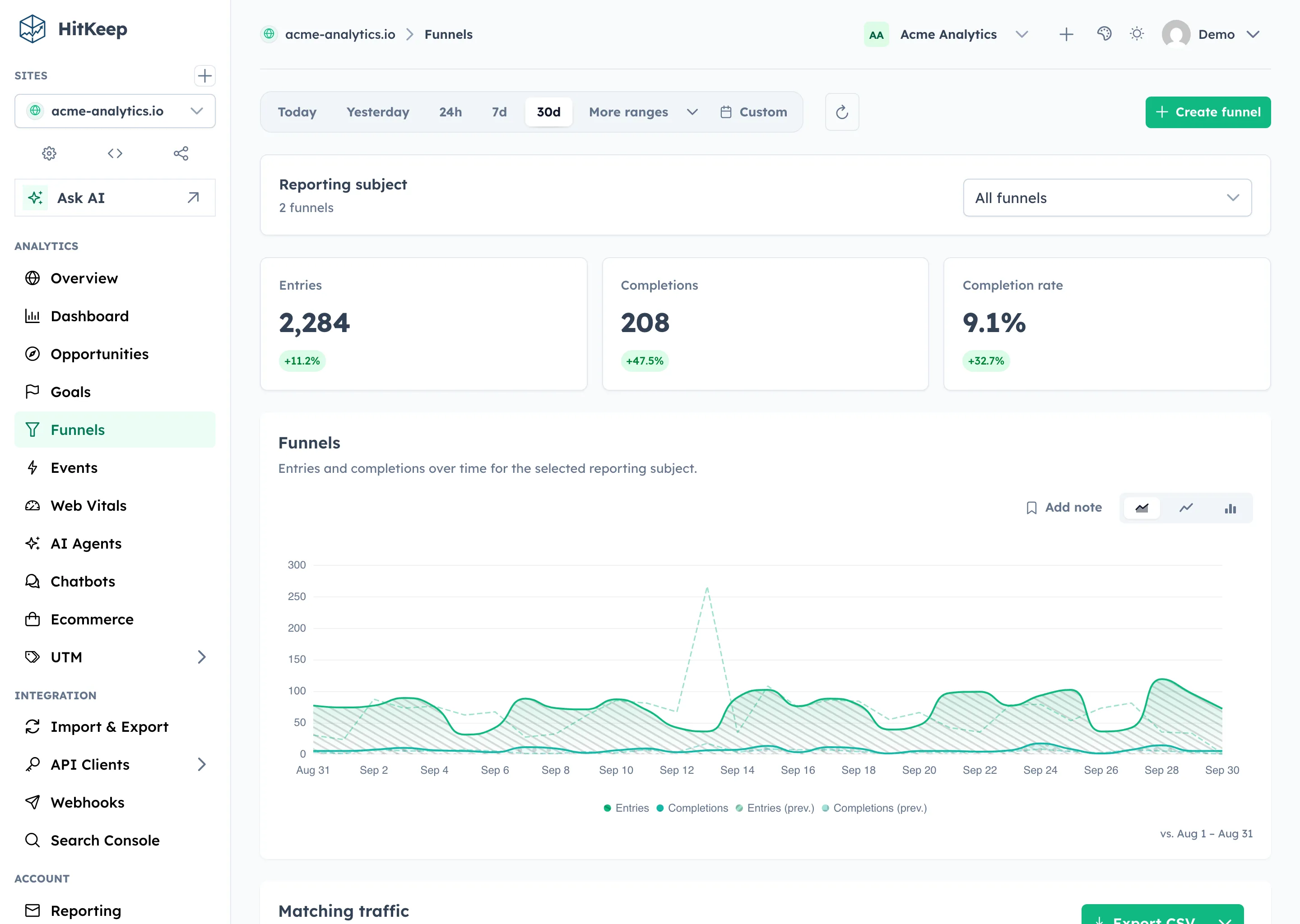
| Funnels | Available | Available |
| Ecommerce analytics | AvailableGA4 event model | LimitedUse custom events |
| Landing and exit pages | Available | Available |
| Period-over-period comparison | Available | AvailableAutomatic previous-period KPI deltas |
| UTM reporting | Available | Available |
| QR campaigns | Available | Not documented |
| Google Search Console Search Analytics import | AvailableAggregate rows only | Plan-dependentCloud |
| Dashboard languages | 7: EN, DE, ES, FR, IT, NL, PT | 12: EN, DE, FR, ZH, ES, PL, IT, KO, PT, JA, CS, UK |
| Hostname / referrer host filters | Available | Not documented |
| Access, automation, and operations | ||
| Team single sign-on | Plan-dependentOIDC: Business on Cloud; included self-hosted | Plan-dependentEnterprise SSO |
| Google, GitHub, and Microsoft social sign-in | Available | Not documented |
| Scheduled email reports | Available | Plan-dependentWeekly reports on Cloud |
| Shareable dashboards | AvailableRead-only share links | AvailablePublic analytics and generated private embed links |
| Team collaboration / RBAC | Available | Plan-dependentPlan-dependent |
| WebAuthn passkeys + TOTP MFA | Available | Not documented |
| Recovery codes for MFA | Available | Not documented |
| Data takeout formats | AvailableJSON, CSV, Parquet, NDJSON, XLSX where supported | Plan-dependentRaw data access |
| MCP analytics server | AvailableOptional; API client tokens | AvailableOfficial server with read and write tools |
| Bot filtering for pageviews and events | AvailableMatomo referrer spam + Spamhaus DROP / DROPv6 | AvailableAdvanced built-in filtering |
| License | MIT | AGPL 3.0 |
| Product analytics depth | ||
| Session replay | Unavailable | Plan-dependentPro on Cloud; available self-hosted |
| Error tracking | Unavailable | Available |
| User journeys | Unavailable | Available |
| AI visibility analytics | Available | Not documented |
| On-site AI chatbot analytics | Available | Not documented |
Quick Answer
Section titled “Quick Answer”HitKeep is the better choice if you want:
- self-hosting without managing ClickHouse or Docker Compose
- managed cloud with explicit EU or US region choice
- built-in email reports, share links, and role-based permissions
- the same open-source analytics foundation across self-hosting and managed cloud
- MIT licensing without copyleft obligations
Rybbit is stronger if you want:
- session replay to watch individual user sessions
- built-in error tracking
- user journey visualizations showing full navigation paths
- a product analytics platform rather than aggregate web analytics
Where HitKeep Is Better
Section titled “Where HitKeep Is Better”HitKeep’s signed webhooks are for operational changes such as goal conversions, imports, sites, teams, and users. They do not transmit session replay or raw visitor histories, which matches the product’s smaller privacy and storage boundary.
1. Simpler self-hosting
Section titled “1. Simpler self-hosting”Rybbit’s current Docker Compose stack runs its client and backend with ClickHouse, PostgreSQL, and Redis. Caddy is optional through the with-webserver profile. That is a real multi-service stack:
- you are managing container orchestration, not just running a binary
- backups require coordinating across services
HitKeep keeps the runtime minimal:
- one Go binary with memory use covered in Facts and Limits
- embedded DuckDB with batch appender for high-throughput ingest
- embedded NSQ for internal messaging
- database files contained under the configured data directory, without coordinating a separate ClickHouse service
If your requirement is “privacy analytics without turning it into a platform project”, HitKeep is the smaller operating model. Size it from the current Facts and Limits guidance rather than a fixed VPS price claim.
2. No ClickHouse to manage
Section titled “2. No ClickHouse to manage”ClickHouse is a capable columnar database, but it is also a real operational commitment:
- memory tuning
- disk management and compaction
- database upgrades
- monitoring and alerting
HitKeep embeds DuckDB directly, so analytical storage stays inside the HitKeep process instead of requiring a separate database service.
3. Cleaner cloud and self-hosted story
Section titled “3. Cleaner cloud and self-hosted story”HitKeep runs as:
- self-hosted OSS (single binary)
- managed cloud in EU Frankfurt
- managed cloud in US Virginia
HitKeep Cloud and self-hosting use the same open-source product foundation. Rybbit’s managed service is hosted in Germany, and its self-hosted code uses the AGPL 3.0 license.
4. Governed API access and site-scoped roles
Section titled “4. Governed API access and site-scoped roles”HitKeep documents:
- scheduled email reports
- shareable read-only dashboards
- instance-level and per-site roles
- team-owned and personal API clients
- a dashboard in 7 languages (EN, DE, ES, FR, IT, NL, PT)
Rybbit is not missing the basic collaboration surface: its current docs cover weekly Cloud email reports, public analytics, generated private dashboard embeds, organization roles, and 12 dashboard languages. Compare plan and deployment availability directly. HitKeep’s distinct angle here is its documented team-owned and personal API clients plus site-scoped permission model, not an absence of reporting or sharing in Rybbit.
5. Better fit for AI-era content and product reporting
Section titled “5. Better fit for AI-era content and product reporting”HitKeep now includes:
- AI visibility analytics for AI crawler fetches and later AI-referred visits
- AI chatbot analytics for on-site assistant conversations, citations, handoffs, and assisted conversions
That matters if AI assistants are becoming part of both your acquisition mix and your product surface. Rybbit is still stronger where session replay and journey inspection are the priority; HitKeep is sharper where you want aggregate reporting on AI discovery and chatbot outcomes.
6. MIT and AGPL are different operating choices
Section titled “6. MIT and AGPL are different operating choices”HitKeep uses the permissive MIT license. Rybbit uses AGPL 3.0, a network copyleft license.
That distinction can matter to organizations with policies around copyleft or software offered over a network. Review the actual licenses and get legal advice for your intended use instead of treating a comparison page as a license opinion.
7. Better data portability
Section titled “7. Better data portability”HitKeep supports data takeout in JSON, CSV, Parquet, NDJSON, and XLSX where supported. Combined with retention policies and Parquet archiving, this gives operators open files for archiving, warehouse analysis, or a separately planned migration.
Where Rybbit Is Better
Section titled “Where Rybbit Is Better”1. Session replay is a real differentiator
Section titled “1. Session replay is a real differentiator”Rybbit’s session replay lets you watch individual user sessions to identify usability issues, broken flows, and confusion points.
HitKeep does not offer session replay. It focuses on aggregate analytics: pageviews, events, funnels, and conversions. If watching individual user sessions is a core requirement, Rybbit has a clear advantage.
2. Built-in error tracking
Section titled “2. Built-in error tracking”Rybbit includes error detection and reporting directly in the analytics platform. HitKeep does not track JavaScript errors: you would need a separate tool like Sentry for that.
3. User journey visualizations
Section titled “3. User journey visualizations”Rybbit can show complete navigation paths from landing to conversion. HitKeep has funnels (predefined step sequences), but not open-ended journey mapping.
4. Web Vitals scope
Section titled “4. Web Vitals scope”Both products can report Web Vitals. HitKeep keeps this opt-in and aggregate-first: LCP, INP, CLS, FCP, and TTFB p75 values, rating counts, and page breakdowns without session replay or attribution/debug payloads.
5. Bot and spam filtering
Section titled “5. Bot and spam filtering”Rybbit has built-in advanced bot detection and filtering. HitKeep does not try to be a full bot-management platform, but in the current product it includes an OSS baseline that is much stronger than simple IP suppression alone:
- IP exclusions for your own traffic and known infrastructure
- bot and spam filtering using the Matomo referrer spam list at pageview ingest
- Spamhaus DROP and DROPv6 network suppression at ingest time for both pageviews and custom events
hostnameandreferrer_hostfilters for investigating noisy traffic after it is stored
If you need challenge flows, fingerprinting, or anti-abuse scoring, Rybbit or a dedicated edge security product still has the advantage.
6. Broader framework integrations
Section titled “6. Broader framework integrations”Rybbit documents 40+ framework integrations (Next.js, React, Vue, WordPress, Shopify). HitKeep provides a universal JavaScript snippet and a REST API for server-side tracking.
HitKeep Technical Facts
Section titled “HitKeep Technical Facts”| Check | HitKeep fact |
|---|---|
| Deployment model | Self-hosted single Linux binary or managed EU/US cloud |
| External services | Embedded DuckDB and NSQ; no PostgreSQL, Redis, Kafka, ClickHouse, separate queue, cache, or database service for core analytics |
| Binary size and memory | Current Linux release binaries are about 100 MB; size memory from Facts and Limits for the intended workload |
| Storage and backups | DuckDB files live under the configured data directory; multiteam deployments include tenants/*/hitkeep.db |
| Privacy behavior | hk.js sets no analytics cookies, uses sessionStorage for session continuity, and respects DNT unless configured otherwise |
| Custom tracking domains | Team admins can verify multiple tracker hostnames; active team domains serve hk.js, hk-vitals.js, and browser ingest for every site in that team. Site Settings can generate snippets from the instance URL or any active team domain. |
| Automatic events | outbound_click, file_download, and form_submit |
| Exports and non-replacements | JSON, CSV, Parquet, NDJSON, and XLSX where supported; HitKeep does not replace session replay, feature flags, experimentation, CMP, SIEM, CRM, or a warehouse used as the system of record |
| Chart annotations | From 2.14.0: team notes for a point in time or a date range on every chart, readable through the REST API, read-only MCP, and Ask AI; not shown on public share links |
Rybbit also offers timeline annotations on its charts, with emoji markers and custom notes.
What HitKeep Does Not Replace
Section titled “What HitKeep Does Not Replace”Be realistic before choosing:
- session replay: HitKeep does not record user sessions
- error tracking: you will need a separate tool
- Web Vitals attribution/debug payloads: HitKeep reports aggregate p75 and page breakdowns, not selector-level diagnostics
- user journey mapping: HitKeep has funnels, not open-ended journeys
If session replay and error tracking are core requirements, Rybbit or a dedicated product analytics tool is the better choice.
When To Choose HitKeep Instead of Rybbit
Section titled “When To Choose HitKeep Instead of Rybbit”Choose HitKeep when:
- you want self-hosting without ClickHouse and Docker Compose
- you want managed cloud with explicit EU or US region choice
- you need aggregate analytics, goals, funnels, and ecommerce: not session-level recording
- you care about MIT licensing
- you want email reports, shareable dashboards, and RBAC out of the box
- operational simplicity matters more than product analytics depth
When To Choose Rybbit Instead of HitKeep
Section titled “When To Choose Rybbit Instead of HitKeep”Choose Rybbit when:
- session replay is a core requirement
- you need built-in error tracking and Web Vitals
- user journey visualization matters
- you are comfortable managing a Docker Compose stack with ClickHouse, PostgreSQL, and Redis
- the AGPL licensing model fits your organization
Migration Notes
Section titled “Migration Notes”There is no direct Rybbit importer. Run HitKeep beside Rybbit, compare aggregate traffic, events, goals, funnels, and ecommerce reporting, then decide whether you still need session replay and ClickHouse-backed product analytics.
Use HitKeep Cloud when you want to test the reporting surface before touching your Docker Compose stack. Use self-hosted HitKeep when the migration goal is one binary, embedded DuckDB, and fewer moving parts.
Frequently Asked Questions
Section titled “Frequently Asked Questions”Is HitKeep a good alternative to Rybbit?
Section titled “Is HitKeep a good alternative to Rybbit?”Yes, if self-hosting simplicity is a priority. HitKeep deploys as a single binary with no external databases, while Rybbit’s current Docker Compose stack includes ClickHouse, PostgreSQL, and Redis. HitKeep also offers managed cloud in EU or US regions on the same open-source analytics foundation; managed operations and some team features depend on the Cloud plan.
Does Rybbit have session replay?
Section titled “Does Rybbit have session replay?”Yes. Rybbit includes session replay; current Cloud pricing places it on Pro, and it is available when self-hosted. HitKeep does not offer session replay: it focuses on aggregate analytics, goals, funnels, and ecommerce tracking without recording individual user sessions.
Is HitKeep GDPR compliant?
Section titled “Is HitKeep GDPR compliant?”HitKeep is designed to simplify GDPR compliance: cookie-less by default, self-hosting or EU-hosted cloud, and fewer third-party analytics transfers. Compliance depends on your deployment and legal analysis. Read the Compliance Overview.
Does HitKeep work without cookies?
Section titled “Does HitKeep work without cookies?”Yes. HitKeep uses cookie-less tracking by default. The current tracker uses sessionStorage for session continuity. This is not a cookie, but PECR / ePrivacy analysis still applies depending on jurisdiction.
Can I self-host Rybbit without ClickHouse?
Section titled “Can I self-host Rybbit without ClickHouse?”No. Rybbit requires ClickHouse for analytics storage; its current Docker Compose stack also runs PostgreSQL and Redis. HitKeep embeds DuckDB directly in its single binary, eliminating the need for an external database.
Can I try HitKeep Cloud before replacing Rybbit?
Section titled “Can I try HitKeep Cloud before replacing Rybbit?”Yes. Start with one site in HitKeep Cloud, keep Rybbit running, and compare whether aggregate reporting covers your needs before changing your ClickHouse stack.
Does Rybbit have an MCP server?
Section titled “Does Rybbit have an MCP server?”Yes. Rybbit documents an official MCP server for Cloud and self-hosted installs. It includes read and write tools, such as creating goals and funnels, managing team members, and read-only ClickHouse SQL. HitKeep MCP is read-only and aggregate-only, which suits assistants that must not change configuration.
Sources
Section titled “Sources”- Rybbit website
- Rybbit pricing
- Rybbit GitHub repository
- Rybbit autocapture documentation
- Rybbit site settings documentation
- Rybbit account settings documentation
- HitKeep Configuration Reference
- HitKeep Compliance Overview
- Rybbit v2.9.0 release: timeline annotations
- Rybbit MCP server documentation