
HitKeep vs Matomo: Analytics Without PHP or MySQL
Section titled “HitKeep vs Matomo: Analytics Without PHP or MySQL”If you are looking for a Matomo alternative, the real question is not whether Matomo is capable enough. It is.
The real question is:
- do you want a broad analytics platform with a plugin ecosystem, or
- do you want a much simpler analytics product that is easier to run and easier to understand
That trade-off is exactly why so many teams search for “Matomo alternative” in the first place.
Best Fit
Section titled “Best Fit”Choose HitKeep if you want Matomo-style ownership without running PHP, MySQL/MariaDB, premium plugins, or a larger web analytics suite.
Choose Matomo if you need its plugin ecosystem, custom dimensions, segments, mobile SDKs, consent tooling, heatmaps, session recording, or broader enterprise analytics surface.
Fast validation path: start in HitKeep Cloud, track one site next to Matomo, and compare goals, events, funnels, and ecommerce reports. Operator path: use the self-hosted installation guide if you want a single binary and embedded DuckDB instead of a PHP/MySQL stack.
Managed Cloud: Compare the Reports You Need
Section titled “Managed Cloud: Compare the Reports You Need”If you already use Matomo Cloud, maintaining PHP or MySQL is not your responsibility. Matomo’s current Cloud offer includes hosting, updates, daily backups, and storage in Frankfurt, Germany. EU hosting alone is therefore not a reason to switch. This Cloud comparison was checked on September 26, 2026.
Choose around the work your team actually does:
| Your requirement | What to evaluate |
|---|---|
| Managed analytics in Europe | Both offer Frankfurt hosting. Compare reporting, access controls, retention, and your contractual requirements. |
| Weekly website and campaign reporting | In HitKeep, test pages, referrers, UTM campaigns, goals, funnels, and exports on one site. |
| Heatmaps, session recordings, or A/B tests | Keep Matomo on your shortlist; HitKeep does not replace these workflows. Check Matomo’s current plan details. |
| Cloud now, self-hosting later | HitKeep has the same open-source foundation in Cloud and self-hosted deployments. Review takeout formats and plan the move; export availability is not automatic migration. |
| Existing Matomo history | HitKeep has no direct Matomo history importer. Keep the old reports accessible under your retention policy. |
For a useful pilot, choose one acquisition report and one conversion goal before installing the tracker. Keep Matomo running during evaluation, compare the same dates and campaign definitions, and document differences in session definitions, bot filtering, and consent settings. Switch only when the replacement answers those questions.
Matomo Alternative Without PHP Or MySQL
Section titled “Matomo Alternative Without PHP Or MySQL”HitKeep belongs on the shortlist when the search is narrower than “Matomo alternative”:
- a self-hosted Matomo alternative without PHP, MySQL/MariaDB, PostgreSQL, ClickHouse, Redis, or Kafka
- a WordPress analytics alternative to Matomo with automatic outbound click, file download, and form tracking
- a smaller analytics product for goals, funnels, ecommerce, UTM reports, email reports, share links, and exports without a plugin marketplace
- a privacy-conscious analytics product with Search Console aggregates, AI visibility analytics, AI chatbot analytics, and read-only MCP reporting
- managed EU or US cloud analytics with the same core reporting model as self-hosted deployments
Quick-Scan Feature Matrix
Compare HitKeep, Matomo Core, and Matomo Premium or Cloud across deployment, reporting, and advanced features.
Swipe or scroll to compare every column.
| Feature | HitKeep baselineHitKeep | Matomo Core | Matomo Premium / Cloud |
|---|---|---|---|
| Deployment and ownership | |||
| Self-hosted runtime | AvailableSingle Linux binary | AvailablePHP + MySQL or MariaDB | UnavailableManaged edition |
| Managed cloud | AvailableEU or US | Unavailable | Available |
| External dependencies | None; DuckDB and NSQ are embedded | MySQL or MariaDB | Vendor-managed stack |
| Published self-hosting guidance | Not documentedNo fixed minimum; sizing depends on traffic and retention | 2 CPU, 2 GB RAM, and 50 GB SSD recommended at up to 100k monthly pageviews | Vendor-managed |
| Hosting cost basis | Infrastructure-dependent | Infrastructure and stack-dependent | Subscription and usage-based |
| Clustering / high availability | AvailableHashiCorp Memberlist | Plan-dependentRequires load-balancer configuration | Vendor-managed |
| Plugin marketplace | Unavailable | Available | Available |
| Tracking and reporting | |||
| Cookieless deployment | Available | Available | Available |
| Dashboard languages | 7: EN, DE, ES, FR, IT, NL, PT | Available50+ | Available50+ |
| Web analytics | Available | Available | Available |
| Goals / conversions | Available | Available | Available |
| Automatic events: outbound clicks, downloads, forms | Available | Plan-dependentPlugin or custom tracking | Plan-dependentPlugin or custom tracking |
| Web Vitals analytics | AvailableOpt-in | Not documented | Not documented |
| First-party WordPress plugin | Available | AvailableVendor-specific plugin | AvailableVendor-specific plugin |
| Funnels | Available | UnavailableNot in Core | Plan-dependentPremium plugin |
| QR campaigns | Available | Not documented | Not documented |
| Landing pages and exit pages | Available | Available | Available |
| Ecommerce analytics | AvailablePurchase, checkout, cart, item views | Available | Available |
| Period-over-period comparison | Available | Available | Available |
| Google Search Console Search Analytics import | AvailableAggregate rows only | Plan-dependentSearch Engine Keywords plugin | Plan-dependentIncluded on Cloud; plugin on On-Premise |
| Hostname / referrer host filters | Available | Available | Available |
| Access, automation, and operations | |||
| Team single sign-on | Plan-dependentOIDC: Business on Cloud; included self-hosted | Not documentedNot documented for Core | Not documentedNot documented for Premium or Cloud |
| Google, GitHub, and Microsoft social sign-in | Available | Not documentedNot documented for Core | Not documentedNot documented for Premium or Cloud |
| Scheduled email reports | Available | Plan-dependentAvailable through plugins | Plan-dependentAvailable through plugins |
| Shareable dashboards | Available | LimitedVaries by setup | LimitedVaries by edition |
| AI visibility analytics | Available | LimitedPartial | LimitedPartial |
| On-site AI chatbot analytics | Available | Not documented | Not documented |
| Built-in spam and bot filtering | AvailableMatomo referrer list + Spamhaus DROP / DROPv6 | LimitedCore controls vary by setup | Plan-dependentMore options; edition-dependent |
| WebAuthn passkeys + TOTP MFA | Available | LimitedTOTP only | LimitedTOTP only |
| Recovery codes for MFA | Available | Available | Available |
| Team-owned API clients | Available | Token-based access | Token-based access |
| MCP analytics server | AvailableOptional; API client tokens | AvailableFree official plugin; optional write actions | AvailableFree official plugin; optional write actions |
| Data takeout formats | AvailableJSON, CSV, Parquet, NDJSON, XLSX where supported | AvailableCSV and API | AvailableCSV and API |
| Advanced analytics | |||
| Segments | Unavailable | Available | Available |
| Custom dimensions | LimitedFocused custom properties | Available | Available |
| Heatmaps / session recording | Unavailable | UnavailableNot in Core | Plan-dependentPremium plugin |
| Form analytics | Unavailable | UnavailableNot in Core | Plan-dependentPremium plugin |
| A/B testing | Unavailable | UnavailableNot in Core | Plan-dependentPremium plugin |
| Mobile SDKs | Unavailable | Available | Available |
Quick Answer
Section titled “Quick Answer”HitKeep is the better Matomo alternative if you want:
- a single binary instead of PHP plus MySQL / MariaDB
- self-hosting with a much smaller ops surface
- managed cloud in the EU or US using the same core analytics surface
- built-in email reports, share links, permissions, and takeout exports
Matomo is stronger if you want:
- broader analytics breadth
- segments, custom dimensions, and mobile SDKs
- premium plugins such as heatmaps, session recording, form analytics, or A/B testing
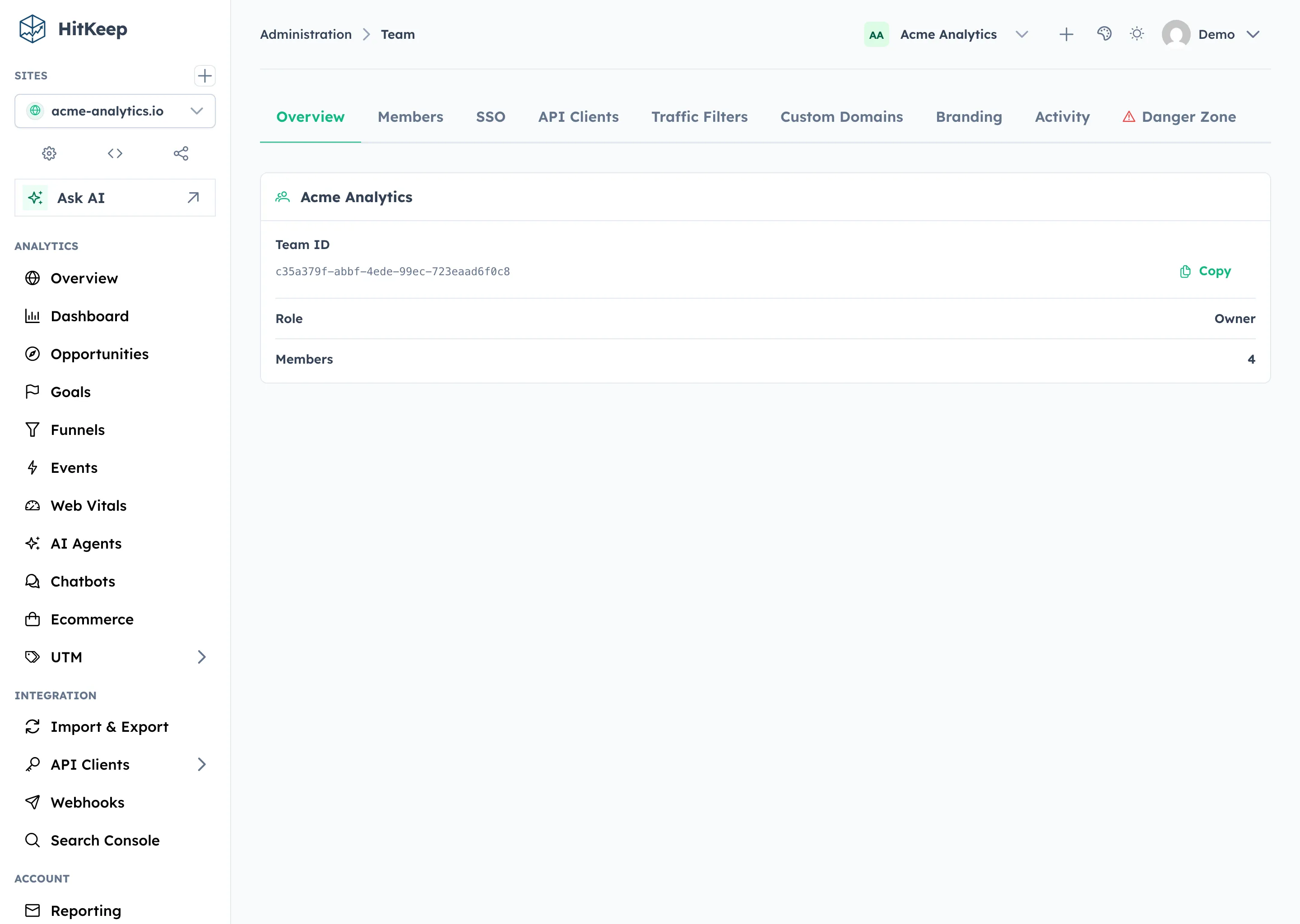
This is where HitKeep is deliberately narrower than Matomo but often more usable: core analytics plus permissions, sharing, API clients, and team operations without turning the product into a plugin platform.
Compliance Note
Section titled “Compliance Note”If your shortlist is privacy-driven, read the Compliance Overview as well.
HitKeep’s strongest compliance advantage is not that it makes legal obligations disappear. It is that it can reduce operational sprawl, third-party exposure, and transfer complexity. But the current public tracker still uses sessionStorage, so PECR / ePrivacy analysis still depends on your deployment and consent approach.
Why Teams Look for a Matomo Alternative
Section titled “Why Teams Look for a Matomo Alternative”Most teams do not switch away from Matomo because it is weak. They switch because it is more platform than they want to operate.
Common reasons:
- too much operational overhead for the actual reporting needs
- too many edition and plugin boundaries
- too much product surface for smaller teams
- desire for simpler ownership and backup workflows
That is where HitKeep is attractive.
Where HitKeep Is Better
Section titled “Where HitKeep Is Better”Signed operational webhooks let a HitKeep installation notify external systems about goals, imports, sites, teams, and users with bounded retries. This is a focused integration surface, not a substitute for Matomo’s broader plugin marketplace.
1. The deployment model is vastly simpler
Section titled “1. The deployment model is vastly simpler”Matomo is still a multi-component application stack. Its official requirements document the usual PHP + MySQL / MariaDB runtime.
HitKeep instead gives you:
- one Go binary, with memory use covered in Facts and Limits
- embedded DuckDB with batch appender for high-throughput ingest
- embedded NSQ for internal messaging
- LRU caching for auth and rate limiters
- no external database, no Redis, no queue service
That makes a major difference for:
- small self-hosted deployments with fewer services to provision
- homelabs
- low-ops teams
- internal tools teams that do not want to run a PHP analytics platform
2. Better fit for teams that want analytics, not a plugin marketplace
Section titled “2. Better fit for teams that want analytics, not a plugin marketplace”HitKeep already covers a strong mid-surface:
- goals
- funnels
- focused ecommerce analytics (GA4-inspired: purchase, begin_checkout, add_to_cart, view_item)
- AI visibility analytics for crawler fetches, downstream AI-referred visits, and directional correlation
- AI chatbot analytics for on-site assistant conversations, handoffs, and assisted conversions
- landing pages and exit pages analysis
- period-over-period comparison with delta badges
- UTM attribution and a UTM builder
- email reports
- share links
- team roles and site ownership
- team-owned and personal API clients
- takeout in JSON, CSV, Parquet, NDJSON, and XLSX where supported
If those are the features you actually use every week, Matomo’s broader platform may be unnecessary overhead.
One of the clearest examples is AI reporting. HitKeep splits AI crawler fetches, later AI-referred visits, and on-site chatbot usage into different product surfaces. That keeps discovery, acquisition, and chatbot performance readable instead of collapsing them into one generic AI bucket.
3. Cloud and self-hosted fit into one cleaner story
Section titled “3. Cloud and self-hosted fit into one cleaner story”HitKeep is no longer only the self-hosted option. You can now choose:
- self-hosted
- HitKeep Cloud in EU Frankfurt
- HitKeep Cloud in US Virginia
without switching to a different product category.
That gives you a cleaner “start where you are, move later if needed” path than a platform that spans many editions and add-ons.
4. Easier ownership and portability
Section titled “4. Easier ownership and portability”HitKeep leans harder into:
- takeout exports in JSON, CSV, Parquet, NDJSON, and XLSX formats where supported
- retention and archiving
- local-first storage when self-hosted
- simpler backup and restore flows (protect the configured data directory instead of orchestrating MySQL dumps)
That is a stronger fit if your requirement is “analytics we control” rather than “analytics platform with the most plugins.”
5. Stronger security defaults
Section titled “5. Stronger security defaults”HitKeep ships with WebAuthn passkeys and TOTP MFA with recovery codes out of the box. No plugin required. Dashboard access is available in 7 languages (EN, DE, ES, FR, IT, NL, PT).
6. Cleaner anti-spam baseline in the default install
Section titled “6. Cleaner anti-spam baseline in the default install”Matomo is the source of the upstream referrer spam list that HitKeep consumes in its new spam filtering pipeline, and one practical advantage in HitKeep is that the default story is easier to explain for smaller teams:
- repo-shipped offline spam list snapshot
- Matomo referrer spam host blocking at pageview ingest
- Spamhaus
DROPandDROPv6network suppression at ingest for both pageviews and custom events - report filtering by
hostnameandreferrer_host
Both the /ingest (pageview) and /ingest/event (custom event) endpoints are covered in the current spam-filtering pipeline. For teams that mainly want clean web analytics rather than a fully extensible analytics platform, that default is easier to reason about and easier to operate.
Where Matomo Is Better
Section titled “Where Matomo Is Better”1. Matomo is still much broader
Section titled “1. Matomo is still much broader”Matomo’s docs cover:
If you need breadth first, Matomo is still the safer choice.
2. Premium plugins extend it far beyond HitKeep
Section titled “2. Premium plugins extend it far beyond HitKeep”Its premium/plugin docs cover:
If you want one analytics platform that can expand into qualitative research tooling, Matomo is far ahead.
3. Mobile analytics and long-tail integrations are stronger
Section titled “3. Mobile analytics and long-tail integrations are stronger”Matomo remains better for teams that want to unify a broader set of analytics and marketing use cases in one platform.
HitKeep Technical Facts
Section titled “HitKeep Technical Facts”| Check | HitKeep fact |
|---|---|
| Deployment model | Self-hosted single Linux binary or managed EU/US cloud |
| External services | Embedded DuckDB and NSQ; no PostgreSQL, Redis, Kafka, ClickHouse, separate queue, cache, or database service for core analytics |
| Runtime shape | One Linux binary with embedded storage and queueing; capacity depends on traffic, retention, and deployment configuration |
| Storage and backups | DuckDB files live under the configured data directory; multiteam deployments include tenants/*/hitkeep.db |
| Privacy behavior | hk.js sets no analytics cookies, uses sessionStorage for session continuity, and respects DNT unless configured otherwise |
| Custom tracking domains | Team admins can verify multiple tracker hostnames; active team domains serve hk.js, hk-vitals.js, and browser ingest for every site in that team. Site Settings can generate snippets from the instance URL or any active team domain. |
| Automatic events | outbound_click, file_download, and form_submit |
| Exports and non-replacements | JSON, CSV, Parquet, NDJSON, and XLSX where supported; HitKeep does not replace enterprise attribution, CMP, SIEM, CRM, warehouse, feature flag, or experimentation workflows |
| Chart annotations | From 2.14.0: team notes for a point in time or a date range on every chart, readable through the REST API, read-only MCP, and Ask AI; not shown on public share links |
Matomo also offers annotations on evolution graphs, including starred annotations that stand out in the chart.
What HitKeep Still Does Not Replace
Section titled “What HitKeep Still Does Not Replace”Be explicit before switching:
- segments
- mature custom dimensions
- mobile analytics
- premium plugin classes such as heatmaps or form analytics
- the wider Matomo marketplace
If those features matter, Matomo should stay in the evaluation set.
When To Choose HitKeep Instead of Matomo
Section titled “When To Choose HitKeep Instead of Matomo”Choose HitKeep when:
- you want a serious Matomo alternative with much less ops overhead
- you mainly need web analytics, funnels, ecommerce, reporting, sharing, and team collaboration
- you want the option of self-hosting or managed cloud without changing tools
When To Choose Matomo Instead of HitKeep
Section titled “When To Choose Matomo Instead of HitKeep”Choose Matomo when:
- you need broader analytics breadth than HitKeep currently offers
- segments and custom dimensions are core to your workflow
- you want a plugin ecosystem and premium analytics add-ons
- your team is comfortable operating a PHP + database stack
Migration Notes
Section titled “Migration Notes”HitKeep does not import Matomo history directly. Run both trackers in parallel, recreate the goals and ecommerce events that matter, and compare whether HitKeep covers the weekly dashboards before changing the old setup.
Use HitKeep Cloud when you want to test the product without replacing your Matomo infrastructure first. Use self-hosted HitKeep when the reason to leave Matomo is reducing the PHP/MySQL operating surface.
Frequently Asked Questions
Section titled “Frequently Asked Questions”Is HitKeep a good alternative to Matomo?
Section titled “Is HitKeep a good alternative to Matomo?”Yes, if your team mainly uses web analytics, funnels, ecommerce, email reports, and team collaboration features. HitKeep covers that surface in a single binary with no external dependencies, versus Matomo’s PHP + MySQL stack. If you rely on Matomo’s segments, custom dimensions, or premium plugins (heatmaps, A/B testing), Matomo is still the better fit.
Can I migrate from Matomo to HitKeep?
Section titled “Can I migrate from Matomo to HitKeep?”HitKeep does not import Matomo historical data. Run both in parallel for a few weeks to validate that HitKeep’s reports answer your weekly questions, then decide. HitKeep’s ecommerce events use GA4-inspired naming, so you will need to update your tracking instrumentation.
Is HitKeep GDPR compliant?
Section titled “Is HitKeep GDPR compliant?”HitKeep has a cookie-less default and a smaller deployment surface than Matomo, but neither product makes a deployment compliant by itself. Hosting, retention, optional features, and local ePrivacy rules still determine the assessment. Read the HitKeep Compliance Overview for details.
Does HitKeep require less server resources than Matomo?
Section titled “Does HitKeep require less server resources than Matomo?”HitKeep removes the separate PHP and MySQL/MariaDB services by embedding DuckDB and NSQ in one binary. Actual resource use depends on traffic and retention. Matomo’s current requirements recommend 2 CPU, 2 GB RAM, and 50 GB SSD for a small deployment up to 100,000 monthly pageviews.
Can I try HitKeep Cloud before replacing Matomo?
Section titled “Can I try HitKeep Cloud before replacing Matomo?”Yes. Start with one site in HitKeep Cloud, keep Matomo running, and compare goals, events, funnels, ecommerce, and email reports before changing your Matomo setup.
Sources
Section titled “Sources”- Matomo requirements
- Matomo goals guide
- Matomo segments guide
- Matomo custom dimensions guide
- Matomo ecommerce analytics guide
- Matomo Search Engine Keywords Performance
- Matomo funnels guide
- Matomo heatmaps and session recording guide
- Matomo form analytics guide
- Matomo A/B testing guide
- CNIL Matomo exemption configuration guide (PDF, French)
- Matomo: Create and edit annotations