
HitKeep vs Vince: Single-Binary Analytics Compared
Section titled “HitKeep vs Vince: Single-Binary Analytics Compared”If you are comparing HitKeep vs Vince, this is not the usual “single binary vs big stack” comparison.
Both products are written in Go. Both avoid external databases. Both are trying to make privacy-friendly analytics deployable on very small infrastructure.
The real split is:
- Vince stays closer to a Plausible-style, single-entity self-hosted product with native automatic TLS and a Plausible-compatible migration path.
- HitKeep pushes further into team workflows, broader analytics depth, exportability, and managed cloud.
Best Fit
Section titled “Best Fit”Choose HitKeep if you like Vince’s low-ops Go direction but need managed cloud, teams, permissions, automatic events, Search Console aggregates, funnels, ecommerce, exports, API clients, and optional MCP access.
Choose Vince if you want a narrower Plausible-compatible self-hosted product with native automatic TLS and a direct migration story from Plausible-style setups.
Fast validation path: start in HitKeep Cloud, add one site, and compare whether team and reporting features are worth the broader surface. Operator path: use the self-hosted installation guide when you want the same single-binary ownership model on your own server.
Vince Alternative With Managed Cloud And Team Controls
Section titled “Vince Alternative With Managed Cloud And Team Controls”HitKeep belongs on the shortlist when the search is narrower than “Vince alternative”:
- a single-binary Go analytics product with managed EU or US cloud as well as self-hosting
- a Plausible-like self-hosting evaluation where team workflows, permissions, funnels, ecommerce, and exports matter
- a WordPress analytics product with automatic outbound click, file download, and form tracking
- a privacy-conscious reporting surface with Search Console aggregates, AI visibility analytics, AI chatbot analytics, and read-only MCP reporting
- a low-ops analytics product that adds teams and stakeholder reporting without external databases
Quick-Scan Feature Matrix
Section titled “Quick-Scan Feature Matrix”| Feature | HitKeep | Vince |
|---|---|---|
| Self-hosted | Single binary | Single binary |
| Managed cloud | EU / US | No |
| Team OIDC SSO | Business on Cloud; included self-hosted | Not publicly documented |
| Google, GitHub, and Microsoft social sign-in | Yes | Not publicly documented |
| External dependencies | None (embedded DuckDB + NSQ) | None |
| Storage model | Embedded DuckDB | Custom roaring-bitmap columnar storage |
| Automatic TLS | Reverse proxy / ingress recommended | Native Let’s Encrypt |
| Plausible-compatible script path | No | Yes |
| Unlimited sites | Yes | Yes |
| Multi-tenant / team model | Yes | No (single-entity focus) |
| Goals / custom events | Yes | Yes |
Automatic events (outbound_click, file_download, form_submit) | Yes | Plausible-compatible events |
| Web Vitals analytics | Yes, opt-in | Not documented |
| First-party WordPress plugin | Yes | Vendor-specific |
| Funnels | Yes | No |
| Chart annotations | Yes, from 2.14.0 | Not documented |
| Ecommerce analytics | Yes | No |
| QR campaigns | Yes | Not publicly documented |
| Period-over-period comparison | Yes | Yes |
| 404 auto-tracking | No | Yes |
| Public / shared dashboards | Yes | Yes |
| Scheduled email reports | Yes | Not documented |
| Google Search Console Search Analytics import | Yes, aggregate rows only | Not documented |
| AI visibility analytics | Yes | Not documented |
| On-site AI chatbot analytics | Yes | Not documented |
| Team roles and permissions | Yes | Not documented |
| WebAuthn passkeys + TOTP MFA | Yes | Not documented |
| Data takeout formats | JSON, CSV, Parquet, NDJSON, and XLSX where supported | Not documented |
| Read-only MCP analytics server | Optional read-only MCP over API client tokens | Not documented |
| Clustering / HA | HashiCorp Memberlist | Not documented |
Quick Answer
Section titled “Quick Answer”HitKeep is the better Vince alternative if you want:
- the same low-ops Go deployment model, but with more product depth
- self-hosted OSS or managed cloud in the EU or US
- team management, permissions, email reports, and share links
- funnels, ecommerce analytics, AI visibility, and data takeout
Vince is stronger if you want:
- a narrower single-entity analytics product in Go
- native automatic TLS with no reverse proxy setup
- a more direct path from Plausible’s script model
- built-in outbound link, file download, and 404 tracking
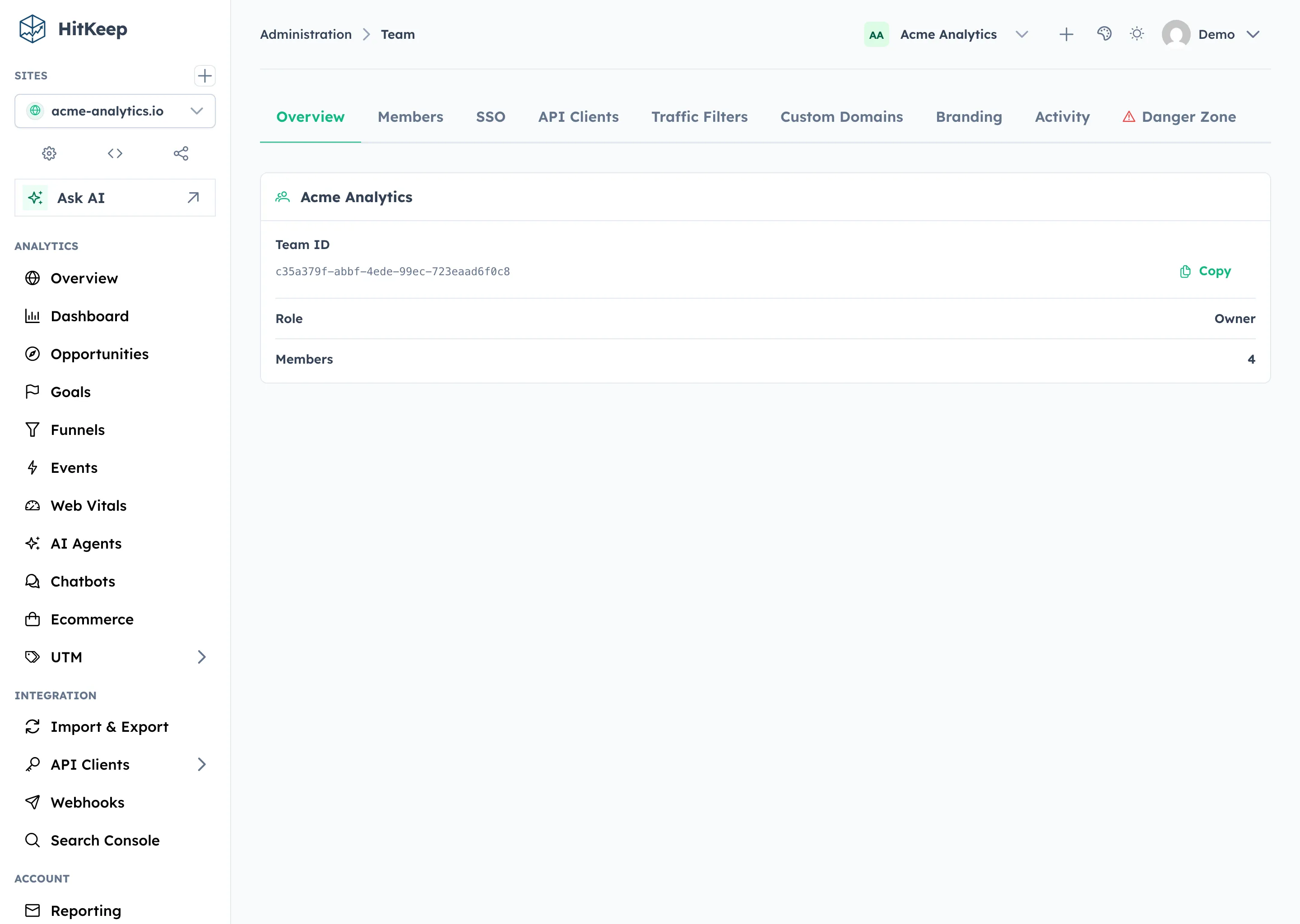
This is where the products really diverge: HitKeep keeps the single-binary deployment model, but adds the team and operator surface that Vince intentionally does not chase.
Compliance Note
Section titled “Compliance Note”If GDPR, PECR, or CCPA / CPRA are part of the evaluation, read the Compliance Overview alongside this page.
Both products position themselves as privacy-friendly self-hosted analytics tools. HitKeep is cookie-less by default, but the current public tracker still uses sessionStorage, so PECR / ePrivacy analysis remains deployment-specific. Do not make the buying decision on a one-line compliance claim alone.
Why Teams Compare HitKeep and Vince
Section titled “Why Teams Compare HitKeep and Vince”This comparison usually comes from one of three starting points:
- a team likes the idea of Plausible, but wants a Go-native self-hosted deployment
- they want privacy analytics without PostgreSQL, ClickHouse, or Node.js
- they want to know whether “single binary” still means “single-admin tool” or whether it can stretch into team workflows
That is why Vince is an interesting comparison. It is much closer to HitKeep philosophically than tools like Matomo or Umami. The trade-off is mostly about scope.
Where HitKeep Is Better
Section titled “Where HitKeep Is Better”HitKeep’s team and managed-cloud workflows can feed internal systems through signed operational webhooks. The events cover goals, imports, sites, teams, and users; they do not expose raw traffic records.
1. Managed cloud exists without abandoning the self-hosted model
Section titled “1. Managed cloud exists without abandoning the self-hosted model”This is the cleanest current product advantage.
You can run HitKeep as:
- self-hosted OSS
- managed cloud in EU Frankfurt
- managed cloud in US Virginia
That matters if you like the single-binary philosophy but do not want to manage upgrades, monitoring, or backups yourself. Vince does not currently offer that middle path.
2. Team workflows and internal reporting are much stronger
Section titled “2. Team workflows and internal reporting are much stronger”HitKeep already includes:
- teams and data isolation
- roles and permissions
- team-owned and personal API clients
- scheduled email reports
- shareable dashboards
That makes HitKeep much easier to use in a real company setup where more than one person needs access and nobody wants to share a single admin login.
3. Broader analytics depth while staying operationally small
Section titled “3. Broader analytics depth while staying operationally small”HitKeep goes beyond core privacy analytics with:
- funnels
- goals
- GA4-inspired ecommerce analytics
- period-over-period comparison
- AI visibility analytics
- AI chatbot analytics
So if the evaluation is really “can we keep the Go single-binary footprint, but answer more business questions?”, HitKeep is the stronger choice.
4. Better portability and operator control
Section titled “4. Better portability and operator control”HitKeep leans harder into documented ownership workflows:
- data takeout in JSON, CSV, Parquet, NDJSON, and XLSX where supported
- retention and archiving
- backups and restore
- S3 backups
- clustering via HashiCorp Memberlist
That makes it a better fit once analytics becomes a real operational dependency instead of a side project.
5. Stronger security surface
Section titled “5. Stronger security surface”HitKeep ships with:
- WebAuthn passkeys + TOTP MFA
- recovery codes
- scoped API clients
- built-in role checks across sites and teams
Vince’s public materials are more focused on deployment simplicity than on multi-user security workflows.
Where Vince Is Better
Section titled “Where Vince Is Better”1. Native automatic TLS is genuinely convenient
Section titled “1. Native automatic TLS is genuinely convenient”Vince includes built-in Let’s Encrypt support. That removes a piece of deployment plumbing that many small self-hosters would otherwise solve with Caddy, nginx, or Traefik.
If your ideal setup is “run one binary on a small VM and get HTTPS without thinking about reverse proxies,” Vince has a real advantage here.
2. The Plausible migration path is more direct
Section titled “2. The Plausible migration path is more direct”Vince explicitly supports existing Plausible scripts and describes itself as a Go port of Plausible focused on self-hosting.
That makes it attractive if your requirement is not “more analytics surface,” but simply:
- keep a Plausible-like model
- switch to Go
- stay self-hosted
- avoid a heavier stack
3. The product scope is intentionally narrower
Section titled “3. The product scope is intentionally narrower”Vince is explicit that it is built for single-entity self-hosting, not for full Plausible feature parity.
That narrower scope can be an advantage if you do not want:
- multi-team administration
- cloud vs OSS product decisions
- broader collaboration workflows
- a larger reporting surface
Sometimes the right answer really is the smaller product.
4. Built-in website interaction tracking is ahead today
Section titled “4. Built-in website interaction tracking is ahead today”Vince ships automatic:
- outbound link tracking
- file download tracking
- 404 page tracking
HitKeep can capture these with custom events, but it does not currently ship those specific reports as first-class built-ins.
HitKeep Technical Facts
Section titled “HitKeep Technical Facts”| Check | HitKeep fact |
|---|---|
| Deployment model | Self-hosted single Linux binary or managed EU/US cloud |
| External services | Embedded DuckDB and NSQ; no PostgreSQL, Redis, Kafka, ClickHouse, separate queue, cache, or database service for core analytics |
| Binary size and memory | Current Linux release binaries are about 100 MB; recent HitKeep Cloud checks showed about 205-769 MiB of memory use |
| Storage and backups | DuckDB files live under the configured data directory; multiteam deployments include tenants/*/hitkeep.db |
| Privacy behavior | hk.js sets no analytics cookies, uses sessionStorage for session continuity, and respects DNT unless configured otherwise |
| Custom tracking domains | Team admins can verify multiple tracker hostnames; active team domains serve hk.js, hk-vitals.js, and browser ingest for every site in that team. Site Settings can generate snippets from the instance URL or any active team domain. |
| Automatic events | outbound_click, file_download, and form_submit |
| Exports and non-replacements | JSON, CSV, Parquet, NDJSON, and XLSX where supported; HitKeep does not replace enterprise attribution, CMP, SIEM, CRM, warehouse, feature flag, or experimentation workflows |
What HitKeep Still Does Not Replace
Section titled “What HitKeep Still Does Not Replace”- native automatic TLS
- the Plausible-compatible script path
- Vince’s built-in outbound, file-download, and 404 tracking
- the appeal of a deliberately narrower single-entity product
If those are your main reasons for choosing Vince, HitKeep is not a drop-in replacement today.
When To Choose HitKeep Instead of Vince
Section titled “When To Choose HitKeep Instead of Vince”Choose HitKeep when:
- you like the Go single-binary idea, but need more than a single-admin dashboard
- you want self-hosted now and the option to move to HitKeep Cloud later
- you need funnels, ecommerce, exports, reports, and team permissions
- you want stronger ownership workflows around backups, takeout, and retention
When To Choose Vince Instead of HitKeep
Section titled “When To Choose Vince Instead of HitKeep”Choose Vince when:
- you want the leanest Go analytics server possible
- automatic TLS matters more than broader analytics depth
- you are moving from Plausible and want the most familiar tracker path
- you do not need teams, cloud, funnels, ecommerce, or advanced operator workflows
Migration Notes
Section titled “Migration Notes”There is no direct Vince importer. Run HitKeep alongside Vince, compare traffic, automatic events, goals, funnels, ecommerce, exports, and team workflows, then decide whether the broader product surface is worth switching.
Use HitKeep Cloud when you want to test the team and reporting workflows without changing your self-hosted Vince setup. Use self-hosted HitKeep when you want the same single-binary ownership model with broader analytics depth.
Frequently Asked Questions
Section titled “Frequently Asked Questions”Is HitKeep a good alternative to Vince?
Section titled “Is HitKeep a good alternative to Vince?”Yes, especially if you want to keep the single-binary Go deployment model but need broader product depth. HitKeep adds managed cloud, teams, permissions, funnels, ecommerce analytics, email reports, and exports while still avoiding external databases.
Is Vince basically Plausible in Go?
Section titled “Is Vince basically Plausible in Go?”Vince describes itself as a Go port of Plausible focused on self-hosting. It supports Plausible-compatible scripts, but its own README is explicit that it targets single-entity self-hosting rather than full Plausible feature parity.
Does Vince have a managed cloud offering?
Section titled “Does Vince have a managed cloud offering?”No. Vince’s public materials position it as a self-hosted product. HitKeep is available both as self-hosted OSS and as managed cloud in EU or US regions.
Can I migrate from Vince to HitKeep?
Section titled “Can I migrate from Vince to HitKeep?”There is no direct Vince importer. The practical migration path is to run both in parallel for a few weeks, compare your reports, then switch tracking once you are confident the dashboards and exports you need are covered.
Can I try HitKeep Cloud before replacing Vince?
Section titled “Can I try HitKeep Cloud before replacing Vince?”Yes. Start with one site in HitKeep Cloud, keep Vince running, and compare whether HitKeep’s teams, reports, exports, and managed option matter enough to switch.