
OpenPanel Alternative: HitKeep vs OpenPanel Analytics
Section titled “OpenPanel Alternative: HitKeep vs OpenPanel Analytics”If you are looking for an OpenPanel Analytics alternative, start with the reports you need and the services you want to operate. This comparison covers OpenPanel Analytics at openpanel.dev.
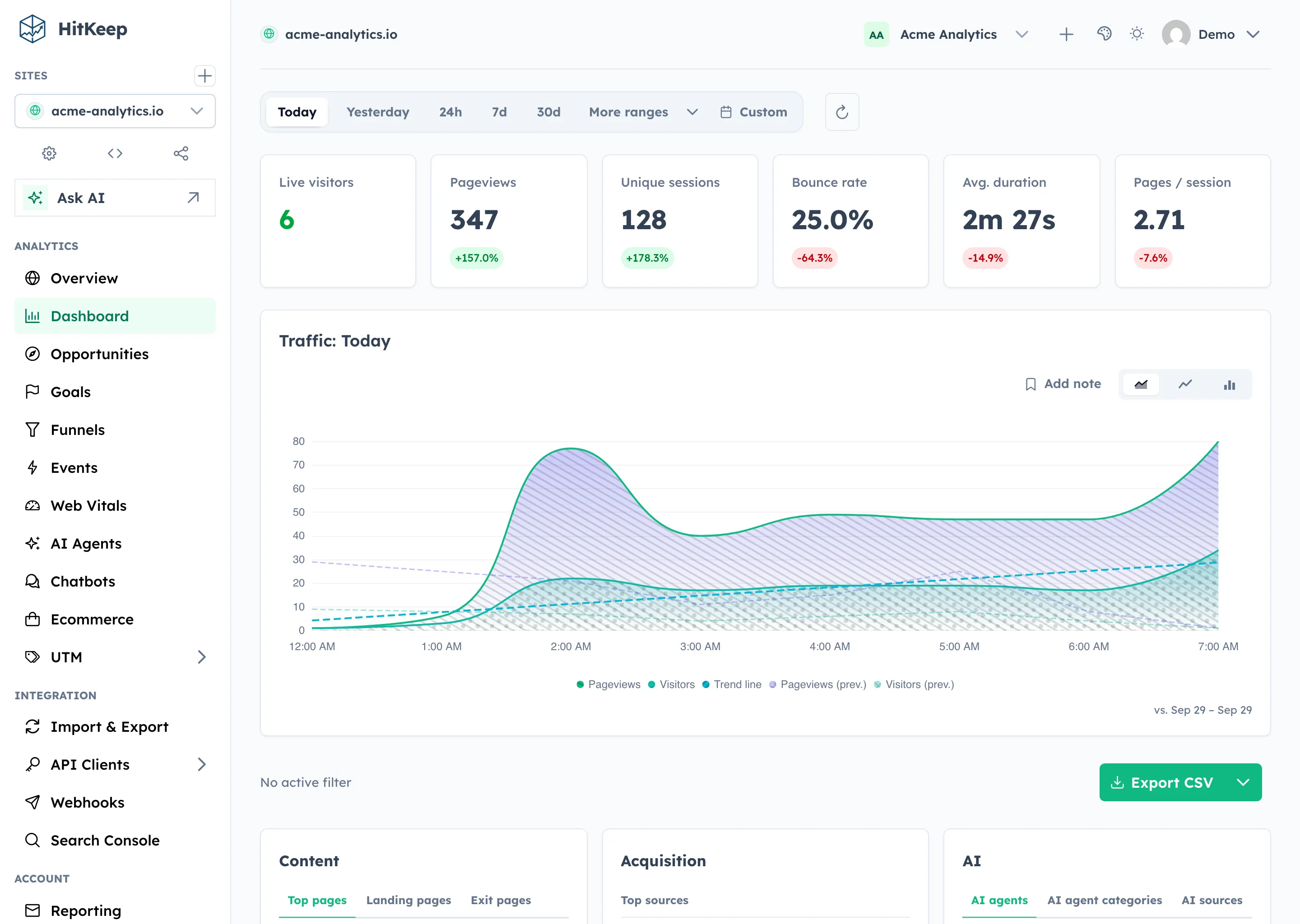
HitKeep is a better fit when you want focused web analytics with one binary, no external services for core analytics, cookie-less tracking by default, open exports, Search Console aggregates, AI visibility reports, and read-only MCP access.
OpenPanel is stronger when you need product analytics: profiles, session history, session replay, A/B testing, mobile SDKs, custom dashboards, revenue tied to users and sessions, and richer event exploration.
Check Cloud pricing and plan limits or review EU and US hosting boundaries before you decide. The comparison below keeps OpenPanel’s strengths and migration limits visible.
Best Fit
Section titled “Best Fit”Choose HitKeep if you want an OpenPanel alternative without ClickHouse, PostgreSQL, Redis, or a product analytics stack. The useful question is not whether OpenPanel has more features. It does. The question is whether you need those features enough to operate the extra services and collect profile-level analytics.
Choose OpenPanel if session replay, user profiles, cohorts, A/B testing, custom dashboards, mobile SDKs, and product analytics are core requirements. OpenPanel is closer to an open-source Mixpanel-style product analytics platform than a narrow pageview dashboard.
Fast validation path: start in HitKeep Cloud, track one site beside OpenPanel, and compare aggregate reporting before changing the self-hosted stack. Operator path: use the self-hosted installation guide when the goal is one binary and one data directory.
OpenPanel Alternative Without ClickHouse
Section titled “OpenPanel Alternative Without ClickHouse”HitKeep belongs on the shortlist when the search is narrower than “OpenPanel alternative”:
- an OpenPanel alternative without ClickHouse
- an OpenPanel alternative without PostgreSQL and Redis
- privacy-first website analytics without session replay
- WordPress analytics with automatic outbound click, file download, and form tracking
- a multilingual dashboard for teams that need English, German, Spanish, French, Italian, Dutch, or Portuguese
- aggregate analytics with Search Console imports, AI visibility, AI chatbot analytics, and read-only MCP reporting
- self-hosted analytics where backups, upgrades, and day-two operations should stay boring
OpenPanel belongs on the shortlist when the search is closer to “open-source Mixpanel alternative”:
- user profiles and session timelines
- session replay with masking and blocking controls
- cohorts, A/B testing, custom dashboards, notifications, and mobile SDKs
- revenue tracking that links purchases to device, profile, and session context
- a broader product analytics workspace, not only public website reporting
Quick-Scan Feature Matrix
Compare HitKeep and OpenPanel across deployment, web analytics, product analytics, and integrations.
Swipe or scroll to compare every column.
| Feature | HitKeep baselineHitKeep | OpenPanel |
|---|---|---|
| Deployment and ownership | ||
| Product focus | Aggregate web analytics | Web and product analytics |
| Self-hosted runtime | AvailableSingle Linux binary | AvailableDocker / application stack |
| Analytics storage | Embedded DuckDB | ClickHouse |
| Control-plane database | Embedded in the HitKeep data directory | PostgreSQL |
| Queue / cache | Embedded NSQ | Redis |
| External services for core analytics | None | PostgreSQL, ClickHouse, Redis |
| Managed cloud | AvailableEU or US region | AvailableOpenPanel Cloud |
| License | MIT | AGPL 3.0 |
| Tracking and reporting | ||
| Cookieless web analytics | Available | Available |
| Default tracker model | Aggregate site analytics | Device, session, and profile analytics |
| Automatic events: outbound clicks, downloads, forms | Available | LimitedCustom event tracking model |
| QR campaigns | Available | Not documented |
| Goals and funnels | Available | Available |
| Ecommerce / revenue reporting | AvailableGA4-inspired ecommerce events | AvailableRevenue events tied to device, profile, and session context |
| Google Search Console Search Analytics import | AvailableAggregate rows only | AvailableDocumented integration |
| Dashboard UI languages | EN, DE, ES, FR, IT, NL, PT | Not documentedEnglish UI; no language switch documented |
| Data exports | AvailableJSON, CSV, Parquet, NDJSON, XLSX where supported | AvailableAPI and export surfaces |
| Access and integrations | ||
| Team single sign-on | Plan-dependentOIDC: Business on Cloud; included self-hosted | Not documented |
| Google, GitHub, and Microsoft social sign-in | Available | Not documented |
| MCP analytics access | AvailableOptional read-only MCP; API client tokens | AvailableOpenPanel documents MCP access |
| Mobile SDKs | UnavailableWeb-focused tracker and HTTP API | AvailableDocumented mobile SDKs |
| Best fit | Operators who want focused analytics with fewer moving parts | Teams that need product analytics depth |
| Product analytics depth | ||
| User profiles | Unavailable | Available |
| Session history | LimitedAggregate sessions and reports | Available |
| Session replay | Unavailable | AvailableOpt-in; masked by default |
| A/B testing | Unavailable | Available |
| Cohorts / retention | Unavailable | Available |
| Custom dashboards and charts | LimitedFocused dashboards | Available |
| AI visibility analytics | Available | Not documentedNo dedicated report documented |
| On-site AI chatbot analytics | Available | LimitedTrackable as custom or product events |
Quick Answer
Section titled “Quick Answer”HitKeep is the better OpenPanel alternative if you want:
- self-hosted analytics without ClickHouse, PostgreSQL, Redis, Kafka, or a separate queue/cache/database service
- one Linux binary with embedded DuckDB and NSQ
- aggregate privacy-first web analytics instead of profile-led product analytics
- managed EU or US cloud with the same core reporting surface available to self-hosted deployments
- WordPress automatic events, goals, funnels, ecommerce, Web Vitals, Search Console aggregates, and open exports
- dashboard UI in English, German, Spanish, French, Italian, Dutch, and Portuguese
- governed read-only MCP access through scoped API client tokens
OpenPanel is stronger if you want:
- session replay
- user profiles and session timelines
- A/B testing, cohorts, retention, and product analytics
- mobile SDKs and richer event instrumentation across apps
- custom dashboards and chart building
- revenue analytics tied to users, devices, and sessions
OpenPanel Alternative Without ClickHouse
Section titled “OpenPanel Alternative Without ClickHouse”OpenPanel documents ClickHouse as the analytics data store for self-hosted deployments. Its high-volume guide also describes Redis buffers that batch events, sessions, and profiles before writing to ClickHouse.
That architecture is reasonable for a product analytics platform. ClickHouse is built for large event workloads, and OpenPanel uses it for a richer analytics model than simple aggregate pageviews.
HitKeep makes a different trade-off. It embeds DuckDB in the application process and writes analytics rows into files under the configured data directory. You do not run a separate ClickHouse service, manage ClickHouse upgrades, tune merge behavior, or coordinate backups across analytics and application databases.
Choose HitKeep here when the requirement is:
- public website analytics
- goals, funnels, ecommerce, UTM reporting, Web Vitals, and AI visibility
- local files that can be backed up as part of one HitKeep data directory
- fewer infrastructure services than a product analytics platform
Choose OpenPanel when ClickHouse is acceptable because you need the broader event, profile, session, replay, and dashboard surface.
OpenPanel Alternative Without PostgreSQL And Redis
Section titled “OpenPanel Alternative Without PostgreSQL And Redis”OpenPanel’s environment-variable documentation lists PostgreSQL for the main database, Redis for caching and queue management, and ClickHouse for analytics storage.
That gives OpenPanel room for product analytics workflows: users, profiles, sessions, events, dashboards, notifications, and revenue context can live in a multi-service architecture.
HitKeep avoids that split for core analytics:
- the application is one Go binary
- DuckDB is embedded for analytics storage
- NSQ is embedded for internal ingest buffering
- no PostgreSQL, Redis, Kafka, ClickHouse, or separate cache/database service is required for core analytics
This is the operator-fit difference. If you want to administer analytics like a small service, HitKeep fits better. If you want product analytics as a platform, OpenPanel’s extra services may be worth carrying.
OpenPanel Alternative For Privacy-First Website Analytics
Section titled “OpenPanel Alternative For Privacy-First Website Analytics”Both products document cookie-less tracking. The difference is the data model around that tracking.
OpenPanel documents device IDs, sessions, profile IDs, user profiles, and session history. Its session replay feature is opt-in and includes privacy controls such as masked inputs, masked text, blocking selectors, and 30-day replay retention.
HitKeep is narrower. The public tracker does not set analytics cookies, respects DNT by default unless configured otherwise, and stores aggregate website analytics fields. IP addresses are processed transiently for trusted-proxy handling, exclusions, rate limiting, spam checks, and metadata lookup. HitKeep stores derived country, region, city, provider, and ASN metadata on hits, not raw visitor IP addresses.
That makes HitKeep a better fit when the privacy review is asking:
- Do we need replay?
- Do we need persistent profiles?
- Do we need product analytics, or only website analytics?
- Can we get useful conversion reporting from aggregate events and funnels?
HitKeep does not remove the need for PECR, ePrivacy, GDPR, CCPA/CPRA, and local legal review. It gives the review a smaller analytics surface to assess.
OpenPanel Alternative For WordPress Analytics
Section titled “OpenPanel Alternative For WordPress Analytics”OpenPanel is developer-friendly and documents web, mobile, server-side, and product analytics use cases. That breadth is useful for SaaS products and apps.
HitKeep is a stronger fit when the job is a WordPress site owner or agency reporting workflow:
- install a first-party WordPress plugin
- connect the site to HitKeep
- enable automatic outbound click, file download, and form tracking
- report pageviews, sources, UTM campaigns, goals, funnels, ecommerce, and Web Vitals
- import Google Search Console Search Analytics aggregates
- export data when the client or operator needs portability
Use Google Analytics alternative for WordPress when the migration question is specifically replacing GA4 on WordPress. Use this page when the question is whether OpenPanel’s product analytics depth is necessary for a WordPress reporting workflow.
OpenPanel Alternative With A Multilingual Dashboard
Section titled “OpenPanel Alternative With A Multilingual Dashboard”HitKeep’s dashboard is fully translated into English, German, Spanish, French, Italian, Dutch, and Portuguese. Users can change the interface language in Settings, and the selected locale follows the user across sessions and devices.
OpenPanel’s public docs and repository do not document a comparable dashboard language switch or locale bundle system. The OpenPanel repository does include translation-style files for property and country labels, but those are not the same as a translated dashboard UI.
The closest GitHub issue found during review was OpenPanel issue #290, where the Next.js SDK had trouble when placed in a nested app/[locale]/[params]/layout.tsx. That is relevant to tracking multilingual sites, but it does not document OpenPanel dashboard multilinguality.
This matters for agencies, EU teams, and customer-facing reporting workflows where the person reading analytics may not want an English-only dashboard.
OpenPanel Alternative Without Session Replay
Section titled “OpenPanel Alternative Without Session Replay”OpenPanel session replay is a real advantage when you need to watch what happened in a user session. Its documentation says replay is opt-in, off by default, built on rrweb, loaded as a separate script, and retained for 30 days. That is useful for debugging confusing flows, finding form issues, and reviewing product behavior.
HitKeep does not offer session replay. It also does not try to hide that gap.
HitKeep is better when session replay is out of scope on purpose:
- public website reporting does not need recordings
- the privacy team wants fewer behavioral artifacts
- operators want aggregate reports, not session playback
- conversion questions can be answered with events, goals, funnels, ecommerce, and UTM reports
OpenPanel is better when replay is part of the product workflow. If watching individual sessions is a requirement, choose OpenPanel or a dedicated replay tool.
OpenPanel Alternative With Search Console, AI Visibility, And Read-Only MCP
Section titled “OpenPanel Alternative With Search Console, AI Visibility, And Read-Only MCP”HitKeep has a different answer for AI-era reporting.
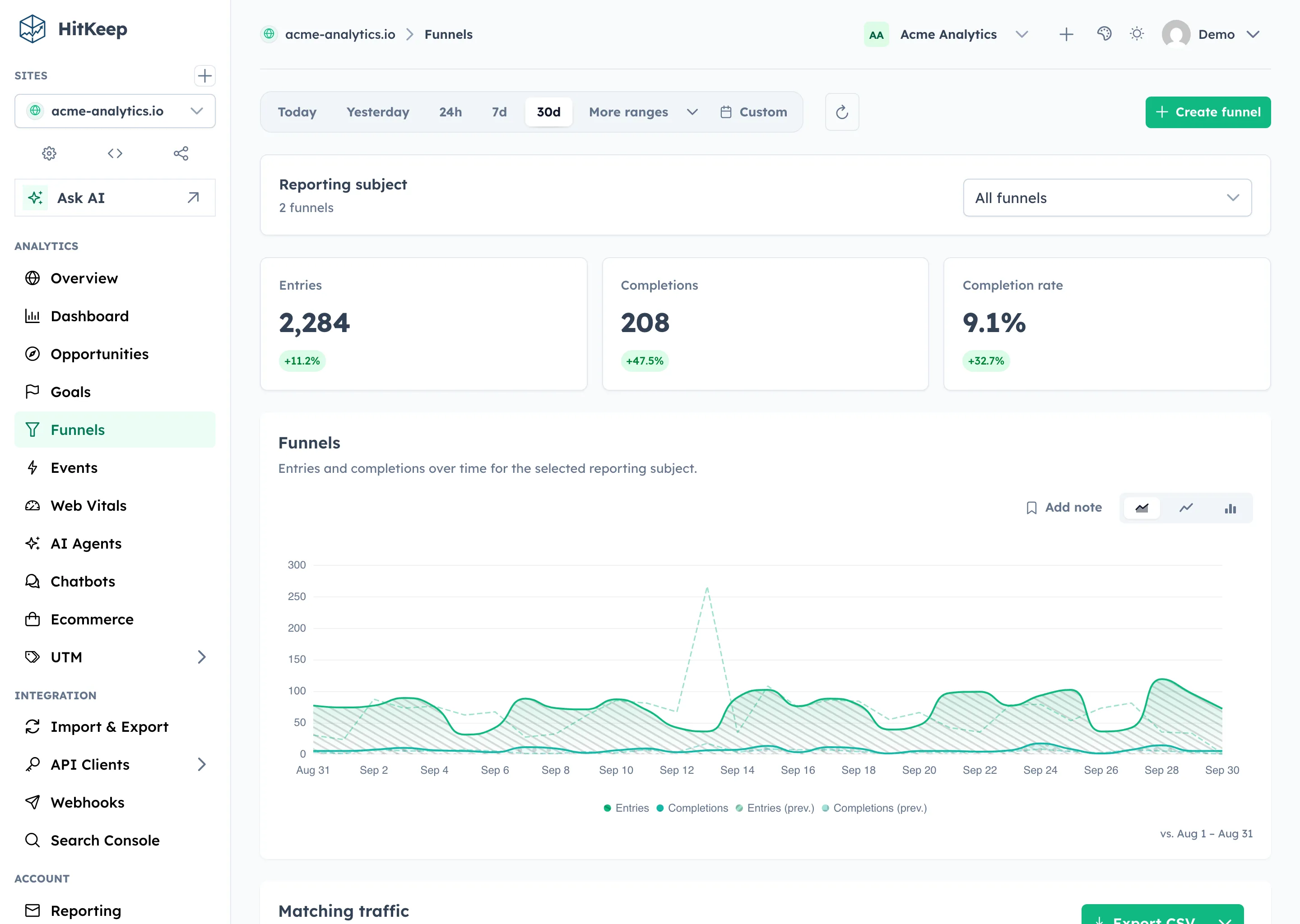
Instead of recording more individual behavior, HitKeep adds reporting surfaces around:
- Google Search Console Search Analytics import for authenticated aggregate organic query data
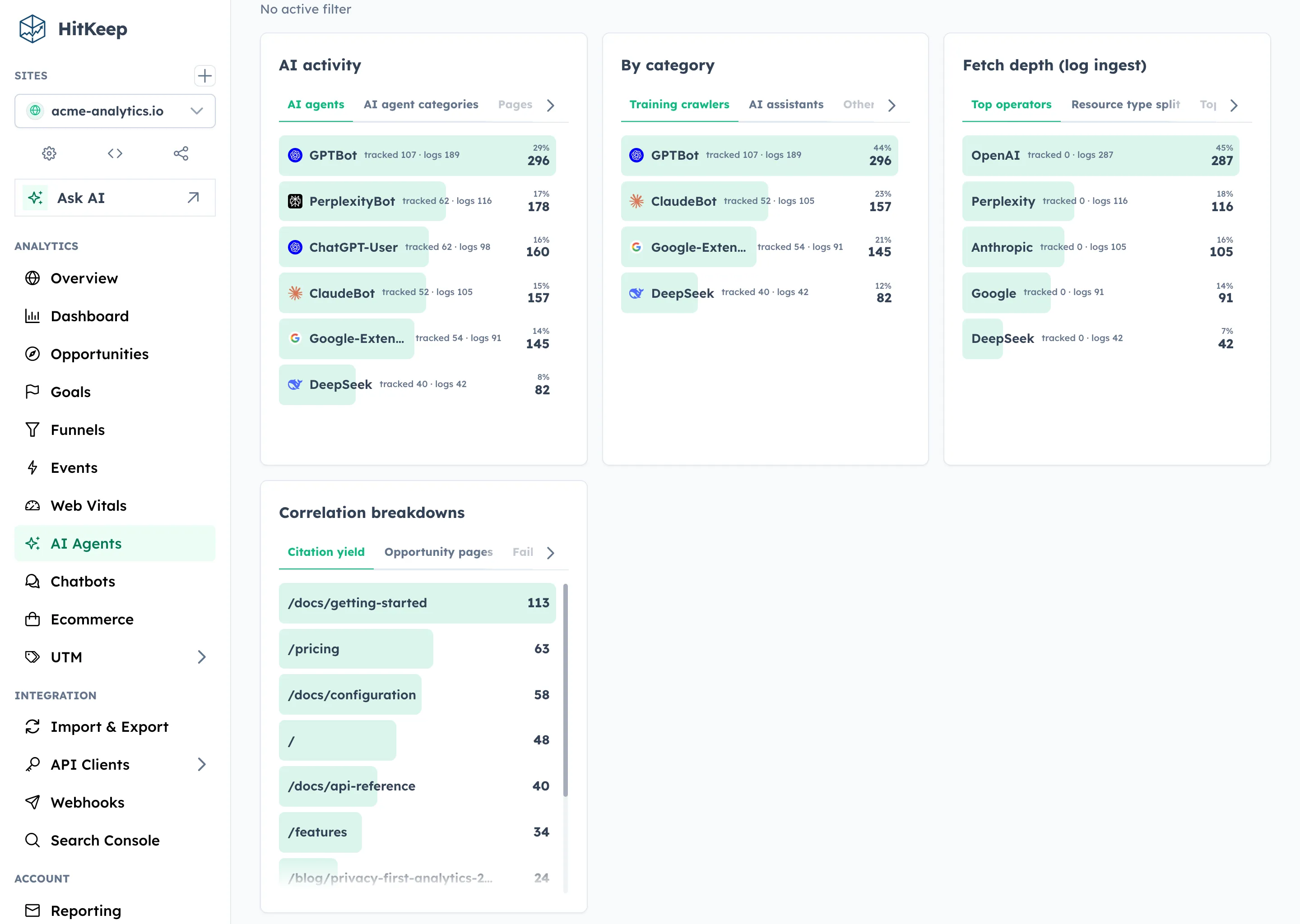
- AI visibility analytics for AI crawler fetches and later AI-referred visits
- AI chatbot analytics for on-site assistant conversations, citations, handoffs, and assisted conversions
- read-only MCP analytics access for approved assistants and internal reporting tools using scoped API client tokens
OpenPanel MCP vs HitKeep MCP
Section titled “OpenPanel MCP vs HitKeep MCP”MCP comparison checked September 5, 2026 against OpenPanel’s official MCP page and the HitKeep MCP guide.
Both official MCP servers are read-only. OpenPanel also supports Google Search Console queries when connected. Read-only access and Search Console alone are therefore not reasons to switch.
| Reporting question | OpenPanel MCP | HitKeep MCP |
|---|---|---|
| What did an individual user do? | Documents user lookup, event timelines, and session history | Aggregate reports; no profile timelines or raw hit exports |
| Where do users drop out? | Documents funnel queries and cohort retention | Reads aggregate results for configured funnels; does not create or modify funnels |
| How is organic search performing? | Queries connected Search Console data | Reads imported Search Console aggregates, sync status, and available dates |
Choose OpenPanel MCP when your assistant needs to investigate users, sessions, or retention cohorts. Choose HitKeep MCP when approved website, conversion, and search aggregates cover the reporting job. HitKeep uses bearer API client tokens with explicit site grants; its MCP surface excludes write, admin, billing, and raw-export operations. Follow the MCP setup guide for configuration and the current tool list.
Where HitKeep Is Better
Section titled “Where HitKeep Is Better”HitKeep webhooks send signed operational changes and keep delivery outcomes. They do not stream profiles, session replay, or product-event histories, which keeps the integration aligned with HitKeep’s aggregate web analytics model.
1. Self-hosting stays small
Section titled “1. Self-hosting stays small”HitKeep deploys as one Linux binary with embedded DuckDB and NSQ. For core analytics, there is no PostgreSQL, Redis, ClickHouse, Kafka, separate queue, cache, or database service to operate.
That matters after day one. Backups, restores, upgrades, monitoring, and incident checks all have fewer moving parts.
2. Aggregate analytics is the product model
Section titled “2. Aggregate analytics is the product model”HitKeep focuses on aggregate website analytics:
- pageviews and sources
- events and automatic events
- goals and funnels
- ecommerce and revenue reports from GA4-inspired events
- UTM reporting
- Web Vitals
- Search Console aggregates
- AI visibility and AI chatbot analytics
If the organization does not want profiles, replay, or product analytics depth, HitKeep is cleaner because those are not half-enabled side features. They are outside the product model.
3. WordPress reporting is first-party
Section titled “3. WordPress reporting is first-party”HitKeep has a first-party WordPress integration and automatic events for common site interactions. That makes it practical for site owners and agencies that want reporting without asking every client to design an event taxonomy first.
4. Open exports are part of the contract
Section titled “4. Open exports are part of the contract”HitKeep supports open export surfaces in JSON, CSV, Parquet, NDJSON, and XLSX where the product surface supports them. It also supports retention archives in Parquet.
Use Facts and Limits before citing exact export surfaces, storage boundaries, memory observations, privacy behavior, or non-goals in procurement material.
5. MIT licensing
Section titled “5. MIT licensing”HitKeep uses the MIT license.
OpenPanel’s GitHub repository lists AGPL 3.0. That may be fine for many teams, especially if they use the hosted product or accept AGPL obligations. It is still a legal review item for organizations with strict copyleft policies.
Where OpenPanel Is Better
Section titled “Where OpenPanel Is Better”1. Product analytics depth
Section titled “1. Product analytics depth”OpenPanel is built for more than website analytics. Its docs describe funnels, cohorts, user profiles, session history, A/B testing, custom dashboards, notifications, SDKs, API access, MCP, revenue tracking, and integrations.
HitKeep does not replace that full product analytics category.
2. Session replay
Section titled “2. Session replay”OpenPanel session replay records structured browser activity with privacy controls and lets teams replay sessions. HitKeep has no replay feature.
If you need to watch users move through a product, OpenPanel wins.
3. Profiles, sessions, and revenue context
Section titled “3. Profiles, sessions, and revenue context”OpenPanel revenue tracking can link payment activity to device IDs, profiles, and sessions. That is useful when you want to understand product journeys and customer behavior over time.
HitKeep ecommerce reporting is aggregate-first. It can report purchases, revenue, products, funnels, and sources when the relevant events exist, but it does not provide product-led profile timelines.
4. Mobile and app instrumentation
Section titled “4. Mobile and app instrumentation”OpenPanel documents mobile SDKs and multi-platform tracking. HitKeep is focused on web analytics and server-side ingest.
If your analytics surface includes mobile apps, authenticated product flows, and server events tied to profiles, OpenPanel is likely a better fit.
HitKeep Technical Facts
Section titled “HitKeep Technical Facts”| Check | HitKeep fact |
|---|---|
| Deployment model | Self-hosted single Linux binary or managed EU/US cloud |
| External services | Embedded DuckDB and NSQ; no PostgreSQL, Redis, Kafka, ClickHouse, separate queue, cache, or database service for core analytics |
| Runtime shape | One Linux binary with embedded storage and queueing; capacity depends on traffic, retention, and deployment configuration |
| Storage and backups | DuckDB files live under the configured data directory; multiteam deployments include tenants/*/hitkeep.db |
| Privacy behavior | hk.js sets no analytics cookies, uses sessionStorage for session continuity, and respects DNT unless configured otherwise |
| Custom tracking domains | Team admins can verify multiple tracker hostnames; active team domains serve hk.js, hk-vitals.js, and browser ingest for every site in that team. Site Settings can generate snippets from the instance URL or any active team domain. |
| Automatic events | outbound_click, file_download, and form_submit |
| Exports and non-replacements | JSON, CSV, Parquet, NDJSON, and XLSX where supported; HitKeep does not replace session replay, feature flags, experimentation, CMP, SIEM, CRM, or a warehouse used as the system of record |
| Chart annotations | From 2.14.0: team notes for a point in time or a date range on every chart, readable through the REST API, read-only MCP, and Ask AI; not shown on public share links |
What HitKeep Does Not Replace
Section titled “What HitKeep Does Not Replace”- session replay: HitKeep does not record or replay sessions
- product analytics profiles: HitKeep does not build profile timelines
- A/B testing: use a dedicated experimentation tool or OpenPanel
- cohorts and retention: HitKeep focuses on aggregate website and conversion reports
- mobile SDK analytics: HitKeep is web-first
- custom dashboard builders: HitKeep ships opinionated dashboards rather than a flexible chart workspace
If those features are central, OpenPanel is the better product.
When To Choose HitKeep Instead Of OpenPanel
Section titled “When To Choose HitKeep Instead Of OpenPanel”Choose HitKeep when:
- the goal is website analytics, not product analytics
- self-hosting should be one binary, not a multi-service stack
- ClickHouse, PostgreSQL, and Redis are more infrastructure than the reporting need justifies
- aggregate privacy-first reporting is enough
- WordPress automatic events matter
- the dashboard needs to work in English, German, Spanish, French, Italian, Dutch, or Portuguese
- Search Console, AI visibility, AI chatbot analytics, and read-only MCP reporting belong in the same analytics workspace
- MIT licensing is easier for your organization
When To Choose OpenPanel Instead Of HitKeep
Section titled “When To Choose OpenPanel Instead Of HitKeep”Choose OpenPanel when:
- session replay is a core requirement
- user profiles and session history are part of the workflow
- you need A/B testing, cohorts, retention, or product analytics depth
- custom dashboards and chart building matter more than operator simplicity
- mobile SDKs are required
- revenue analytics needs to follow users, devices, and sessions
- AGPL licensing is acceptable for your use case
Migration Notes
Section titled “Migration Notes”There is no direct OpenPanel importer in HitKeep.
Run HitKeep beside OpenPanel first:
- Add HitKeep tracking to one site.
- Keep OpenPanel running.
- Compare pageviews, referrers, UTM reports, events, goals, funnels, ecommerce, and Search Console context.
- Check whether HitKeep’s localized dashboard covers the team or client reporting workflow.
- Decide whether OpenPanel’s profiles, replay, cohorts, A/B testing, and custom dashboards are still necessary.
This avoids a false migration decision. If aggregate reporting covers the job, HitKeep can simplify the stack. If the team relies on OpenPanel product analytics, keep OpenPanel or run both tools with separate purposes.
Frequently Asked Questions
Section titled “Frequently Asked Questions”Is HitKeep a good alternative to OpenPanel?
Section titled “Is HitKeep a good alternative to OpenPanel?”Yes, if you want focused web analytics with simpler self-hosting. HitKeep runs as one Linux binary with embedded DuckDB and NSQ, while OpenPanel is a broader web and product analytics platform with PostgreSQL, ClickHouse, and Redis in its documented self-hosted stack.
Can I self-host OpenPanel without ClickHouse?
Section titled “Can I self-host OpenPanel without ClickHouse?”OpenPanel documents ClickHouse as the analytics data store for self-hosted deployments. HitKeep embeds DuckDB directly in the application binary, so core analytics do not require a separate ClickHouse service.
Does HitKeep replace OpenPanel session replay?
Section titled “Does HitKeep replace OpenPanel session replay?”No. HitKeep does not record or replay individual sessions. OpenPanel session replay is a clear advantage when watching user sessions is part of the workflow.
Which tool is better for privacy-first website analytics?
Section titled “Which tool is better for privacy-first website analytics?”HitKeep is the better fit when the requirement is aggregate website analytics with no analytics cookies by default, self-hosting control, open exports, and fewer runtime dependencies. OpenPanel is better when privacy-first tracking must be combined with product analytics, user profiles, session history, and optional replay.
Can I run HitKeep beside OpenPanel before switching?
Section titled “Can I run HitKeep beside OpenPanel before switching?”Yes. Run HitKeep beside OpenPanel on one site, compare pageviews, events, goals, funnels, ecommerce, and reporting workflows, then decide whether OpenPanel’s product analytics and replay features are still necessary.
Does HitKeep support more dashboard languages than OpenPanel?
Section titled “Does HitKeep support more dashboard languages than OpenPanel?”HitKeep documents a translated dashboard in English, German, Spanish, French, Italian, Dutch, and Portuguese. OpenPanel’s public docs and repository do not document comparable dashboard UI localization or locale bundles; the repository translation files found during review cover property and country labels, not a multilingual dashboard UI.
Sources
Section titled “Sources”- OpenPanel official MCP server (checked September 5, 2026)
- HitKeep MCP guide
- OpenPanel docs
- OpenPanel self-hosting
- OpenPanel environment variables
- OpenPanel high-volume setup
- OpenPanel session replay
- OpenPanel revenue tracking
- OpenPanel pricing
- OpenPanel GitHub repository
- OpenPanel GitHub issue #290
- HitKeep Facts and Limits
- HitKeep localization guide
- HitKeep Compliance Overview