
Shareable Dashboards
You want to show analytics to a client, a board member, or the public — without handing out credentials or exposing your admin dashboard. HitKeep share links give read-only access to a single site’s analytics. You create them, you revoke them, your server serves them. No third-party service involved.
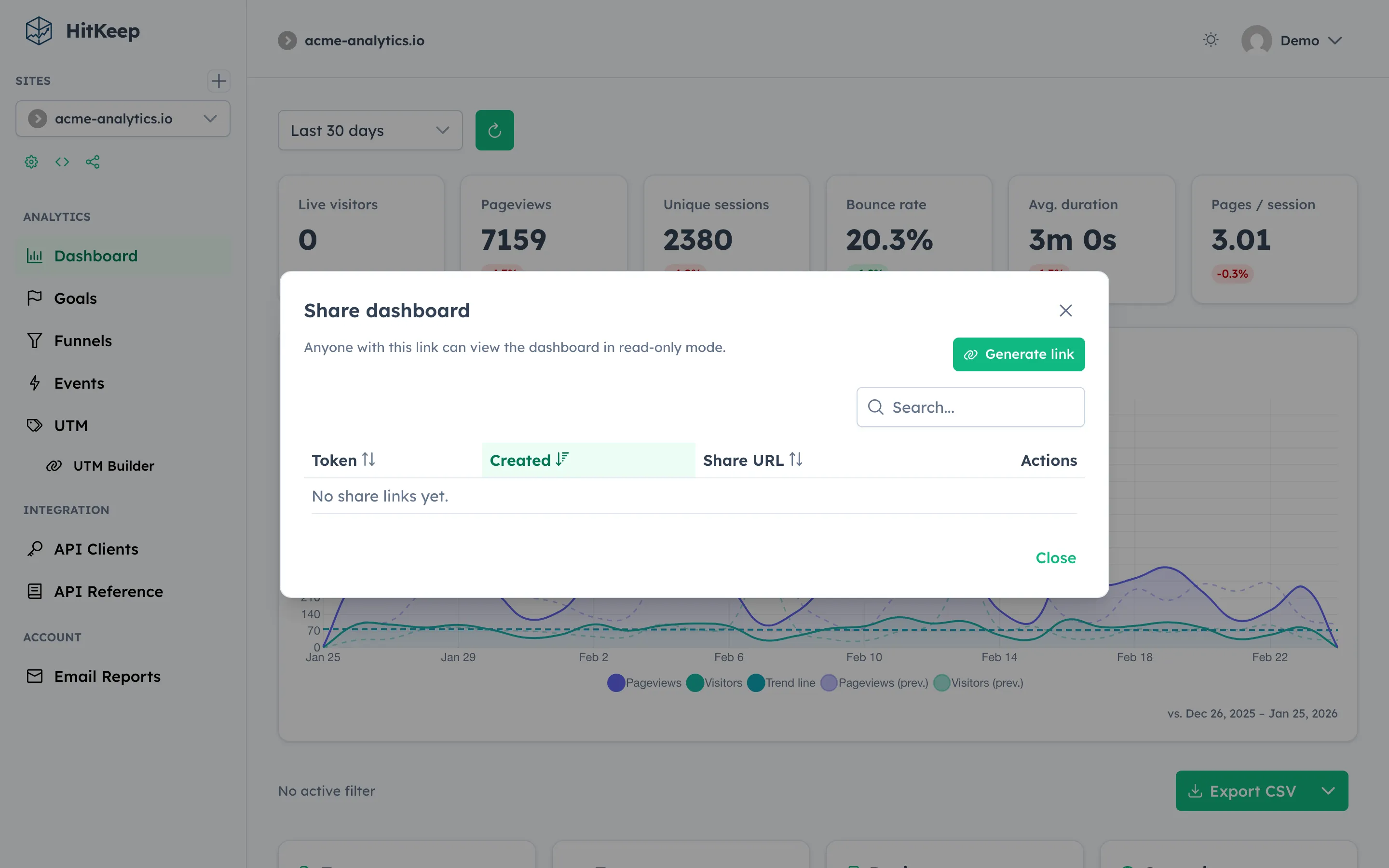
Create a Share Link
Section titled “Create a Share Link”curl -X POST https://your-hitkeep.example/api/sites/{site_id}/share \ -b "hk_token=YOUR_SESSION_COOKIE"Response:
{ "url": "https://your-hitkeep.example/share/SHARE_TOKEN", "token": "SHARE_TOKEN"}Share the url with anyone. Opening it in a browser shows the dashboard — no login, no account, no tracking of who viewed it.
What a Share Link Exposes
Section titled “What a Share Link Exposes”Share links give read-only access to:
- Site overview stats and charts
- Goals and funnel completion data
- Raw hits viewer (read-only)
- CSV export of the hits visible in the time range
They do not expose:
- Admin settings
- Team member lists
- API clients or tokens
- Retention configuration
Revoke a Share Link
Section titled “Revoke a Share Link”Share links can be revoked at any time. The token immediately stops working:
# List active share links for a sitecurl https://your-hitkeep.example/api/sites/{site_id}/share \  -b "hk_token=YOUR_SESSION_COOKIE"
# Revoke a specific share linkcurl -X DELETE https://your-hitkeep.example/api/sites/{site_id}/share/{share_id} \  -b "hk_token=YOUR_SESSION_COOKIE"
You are always in control of who has access. No external OAuth provider, no third-party permission system — just your instance, your tokens.
Public Analytics
Section titled “Public Analytics”Share links can be used to build a public analytics page for your own site — a common transparency practice among open-source projects and government organizations. Point your analytics.example.com/public to the share URL via a redirect, or embed the link as an iframe.
Related
Section titled “Related”HitKeep Cloud → serves share links from your sovereign region (EU or US) — same access control model, zero infrastructure to manage.