
HitKeep vs Rybbit: Single Binary vs ClickHouse Stack
Rybbit is an open-source privacy-first analytics platform with session replay, funnels, and user journeys. It uses ClickHouse for storage and deploys via Docker Compose.
HitKeep takes a different approach: one binary, zero dependencies. No ClickHouse, no Docker orchestration, no multi-service stack.
The real comparison is about what you want to carry operationally and whether you need session replay.
Quick-Scan Feature Matrix
Section titled “Quick-Scan Feature Matrix”| Feature | HitKeep | Rybbit |
|---|---|---|
| Self-hosted | Single binary (~80 MB) | Docker Compose + ClickHouse |
| Managed cloud | EU (Frankfurt) / US (Virginia) | EU (Germany) |
| External dependencies | None (embedded DuckDB + NSQ) | ClickHouse + Caddy |
| Minimum RAM | ~45–64 MB | 2 GB+ (ClickHouse alone) |
| Minimum cost to self-host | ~$6/month VPS | $20+/month |
| Cookie-less analytics | Yes | Yes |
| Session replay | No | Yes (Standard+) |
| Error tracking | No | Yes |
| Web Vitals | No | Yes (Standard+) |
| User journeys | No | Yes (Standard+) |
| Goals / custom events | Yes | Yes |
| Funnels | Yes | Yes |
| Ecommerce analytics | Yes (GA4 event model) | Custom events |
| Landing + exit pages | Yes | Yes |
| Period-over-period comparison | Yes | Limited |
| UTM reporting | Yes | Yes |
| Scheduled email reports | Yes | Not documented |
| Shareable dashboards | Yes | Not documented |
| Team collaboration / RBAC | Yes | Yes (plan-dependent) |
| WebAuthn passkeys + TOTP MFA | Yes | Not documented |
| Recovery codes for MFA | Yes | Not documented |
| Data takeout (JSON, CSV, Parquet) | Yes | Raw data access |
| Dashboard languages | 5 (EN, DE, ES, FR, IT) | English |
| Clustering / HA | HashiCorp Memberlist | Not documented |
| License | MIT | AGPL 3.0 |
| Bot filtering | Basic | Advanced built-in |
Quick Answer
Section titled “Quick Answer”HitKeep is the better choice if you want:
- self-hosting without managing ClickHouse or Docker Compose
- managed cloud with explicit EU or US region choice
- built-in email reports, share links, and role-based permissions
- the same product in OSS and cloud without feature gating
- MIT licensing without copyleft obligations
Rybbit is stronger if you want:
- session replay to watch individual user sessions
- built-in error tracking and Web Vitals monitoring
- user journey visualizations showing full navigation paths
- a product analytics platform rather than aggregate web analytics
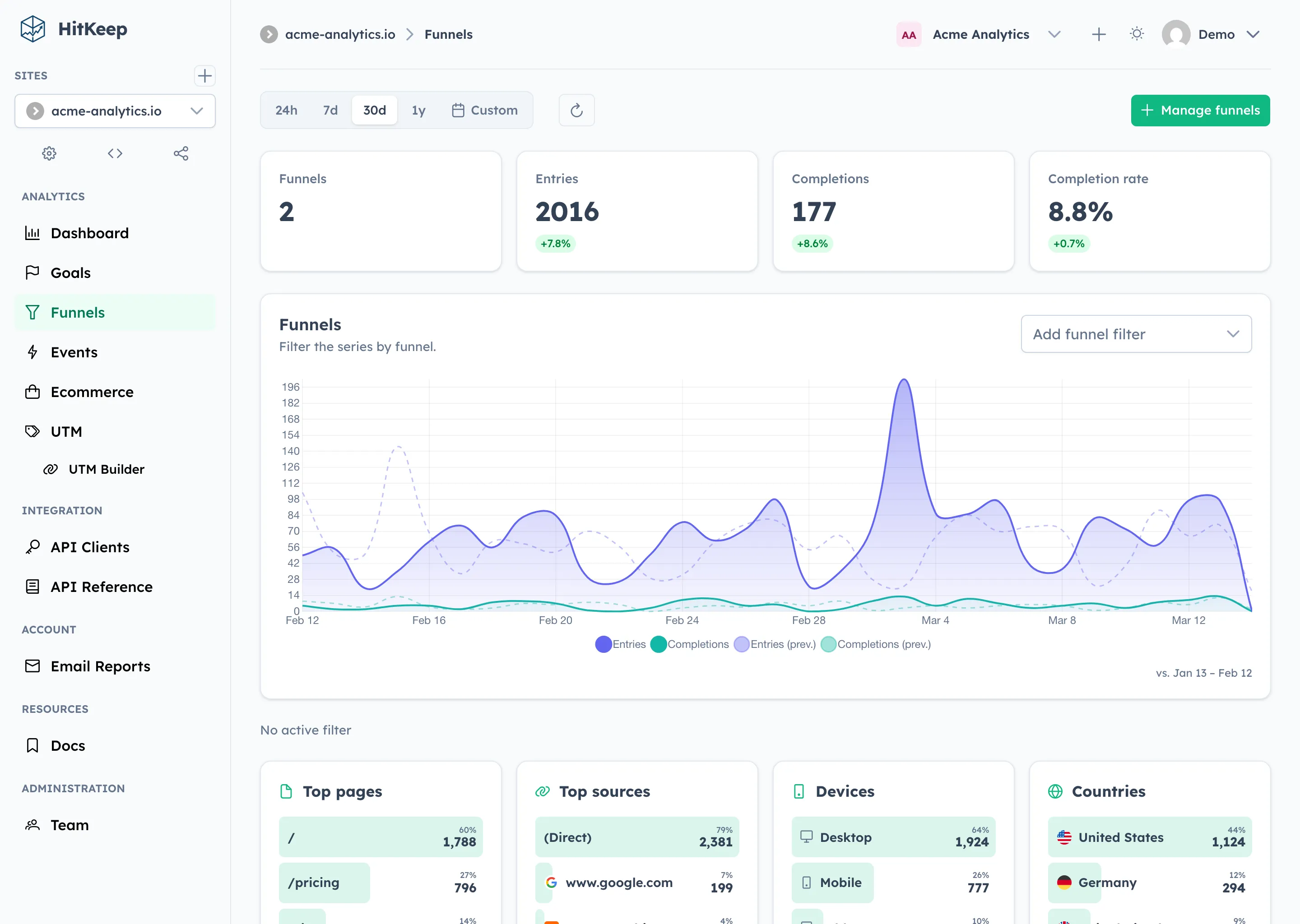
Where HitKeep Is Better
Section titled “Where HitKeep Is Better”1. Dramatically simpler self-hosting
Section titled “1. Dramatically simpler self-hosting”Rybbit requires Docker Compose with ClickHouse, Caddy, and the Rybbit application as separate services. That is a real multi-service stack:
- ClickHouse needs 2 GB+ of RAM on its own
- you are managing container orchestration, not just running a binary
- backups require coordinating across services
HitKeep keeps the runtime minimal:
- one Go binary using ~45–64 MB of RAM
- embedded DuckDB with batch appender for high-throughput ingest
- embedded NSQ for internal messaging
- a single database file to back up
A $6/month VPS is sufficient. If your requirement is “privacy analytics without turning it into a platform project”, HitKeep is a better fit.
2. No ClickHouse to manage
Section titled “2. No ClickHouse to manage”ClickHouse is a powerful columnar database — but it is also a real operational commitment:
- memory tuning
- disk management and compaction
- version upgrades
- monitoring and alerting
HitKeep embeds DuckDB directly. You get columnar OLAP performance (~120 MB per million pageviews) without running a separate database process.
3. Cleaner cloud and self-hosted story
Section titled “3. Cleaner cloud and self-hosted story”HitKeep runs as:
- self-hosted OSS (single binary)
- managed cloud in EU Frankfurt
- managed cloud in US Virginia
Same product, same features, no edition confusion. Rybbit’s cloud is EU-only and the self-hosted version uses AGPL 3.0 licensing.
4. Stronger collaboration and reporting
Section titled “4. Stronger collaboration and reporting”HitKeep includes out of the box:
- scheduled email reports
- shareable read-only dashboards
- instance-level and per-site roles
- team-owned and personal API clients
- a dashboard in 5 languages
These features are not documented in Rybbit’s current offering or are gated behind higher-tier plans.
5. MIT vs AGPL licensing
Section titled “5. MIT vs AGPL licensing”HitKeep uses the MIT license — no copyleft obligations. You can embed, modify, and redistribute without sharing your changes.
Rybbit uses AGPL 3.0, which requires that any modifications to the software — including those running as a network service — must be made available as open source. This matters for organizations with legal policies around copyleft.
6. Better data portability
Section titled “6. Better data portability”HitKeep supports data takeout in JSON, CSV, and Parquet (GDPR Article 20). Combined with retention policies and Parquet archiving, you have full control over your data lifecycle.
Where Rybbit Is Better
Section titled “Where Rybbit Is Better”1. Session replay is a real differentiator
Section titled “1. Session replay is a real differentiator”Rybbit’s session replay lets you watch individual user sessions to identify usability issues, broken flows, and confusion points.
HitKeep does not offer session replay. It focuses on aggregate analytics — pageviews, events, funnels, and conversions. If watching individual user sessions is a core requirement, Rybbit has a clear advantage.
2. Built-in error tracking
Section titled “2. Built-in error tracking”Rybbit includes error detection and reporting directly in the analytics platform. HitKeep does not track JavaScript errors — you would need a separate tool like Sentry for that.
3. Web Vitals monitoring
Section titled “3. Web Vitals monitoring”Rybbit monitors Core Web Vitals (LCP, FID, CLS) as part of its analytics. HitKeep does not collect performance metrics.
4. User journey visualizations
Section titled “4. User journey visualizations”Rybbit can show complete navigation paths from landing to conversion. HitKeep has funnels (predefined step sequences), but not open-ended journey mapping.
5. Advanced bot filtering
Section titled “5. Advanced bot filtering”Rybbit has built-in advanced bot detection and filtering. HitKeep provides basic bot filtering through IP exclusions and header validation.
6. Broader framework integrations
Section titled “6. Broader framework integrations”Rybbit documents 40+ framework integrations (Next.js, React, Vue, WordPress, Shopify). HitKeep provides a universal JavaScript snippet and a REST API for server-side tracking.
What HitKeep Does Not Replace
Section titled “What HitKeep Does Not Replace”Be realistic before choosing:
- session replay — HitKeep does not record user sessions
- error tracking — you will need a separate tool
- Web Vitals monitoring — not part of HitKeep’s scope
- user journey mapping — HitKeep has funnels, not open-ended journeys
If session replay and error tracking are core requirements, Rybbit or a dedicated product analytics tool is the better choice.
When To Choose HitKeep Instead of Rybbit
Section titled “When To Choose HitKeep Instead of Rybbit”Choose HitKeep when:
- you want self-hosting without ClickHouse and Docker Compose
- you want managed cloud with explicit EU or US region choice
- you need aggregate analytics, goals, funnels, and ecommerce — not session-level recording
- you care about MIT licensing
- you want email reports, shareable dashboards, and RBAC out of the box
- operational simplicity matters more than product analytics depth
When To Choose Rybbit Instead of HitKeep
Section titled “When To Choose Rybbit Instead of HitKeep”Choose Rybbit when:
- session replay is a core requirement
- you need built-in error tracking and Web Vitals
- user journey visualization matters
- you are comfortable managing a Docker Compose + ClickHouse stack
- AGPL licensing is acceptable for your organization
Frequently Asked Questions
Section titled “Frequently Asked Questions”Is HitKeep a good alternative to Rybbit?
Section titled “Is HitKeep a good alternative to Rybbit?”Yes, if self-hosting simplicity is a priority. HitKeep deploys as a single binary with no external databases, while Rybbit requires Docker Compose and ClickHouse. HitKeep also offers managed cloud in EU or US regions with no feature gating between self-hosted and cloud.
Does Rybbit have session replay?
Section titled “Does Rybbit have session replay?”Yes. Rybbit includes session replay on its Standard plan and above. HitKeep does not offer session replay — it focuses on aggregate analytics, goals, funnels, and ecommerce tracking without recording individual user sessions.
Is HitKeep GDPR compliant?
Section titled “Is HitKeep GDPR compliant?”HitKeep is designed to simplify GDPR compliance: cookie-less by default, self-hosted or EU-hosted cloud, no third-party data transfers. Compliance depends on your deployment and legal analysis. Read the Compliance Overview.
Does HitKeep work without cookies?
Section titled “Does HitKeep work without cookies?”Yes. HitKeep uses cookie-less tracking by default. The current tracker uses sessionStorage for session continuity. This is not a cookie, but PECR / ePrivacy analysis still applies depending on jurisdiction.
Can I self-host Rybbit without ClickHouse?
Section titled “Can I self-host Rybbit without ClickHouse?”No. Rybbit requires ClickHouse for analytics data storage, deployed via Docker Compose. HitKeep embeds DuckDB directly in its single binary, eliminating the need for any external database.
Sources
Section titled “Sources”- Rybbit website
- Rybbit pricing
- Rybbit GitHub repository
- HitKeep Configuration Reference
- HitKeep Compliance Overview