
HitKeep vs Google Analytics: GA4 Alternative
Questi contenuti non sono ancora disponibili nella tua lingua.
If you are looking for a Google Analytics alternative, the real question is not whether HitKeep has every GA4 feature. It does not.
The real question is whether you still need:
- Google’s ad and app ecosystem
- BigQuery-first workflows
- predictive audiences
- exploration tooling
Or whether what you actually want is a privacy-first web analytics product with:
- traffic, events, goals, funnels, and focused ecommerce analytics
- landing pages and exit pages analysis
- period-over-period comparison with delta badges
- Google Search Console import for finalized aggregate query, page, country, and device rows
- email reports
- share links
- roles and permissions
- data takeout in JSON, CSV, and Parquet
- self-hosting or managed cloud without Google’s operational footprint
For many teams, that second bucket is the real requirement. That is the opening for HitKeep.
Best Fit
Section titled “Best Fit”Choose HitKeep if you mainly use GA4 for web analytics, conversions, ecommerce, campaigns, and stakeholder reports, and you want managed EU/US cloud or a self-hosted database you can export.
Choose Google Analytics 4 if you depend on Google Ads attribution, BigQuery workflows, app analytics, predictive audiences, exploration tooling, or query-to-session attribution.
Fast validation path: start in HitKeep Cloud, install hk.js beside GA4, and compare reports for 2-4 weeks. Operator path: use the self-hosted installation guide when data residency or infrastructure policy is the main reason to leave GA4.
If the migration question is specifically “can we replace GA4 with a self-hosted analytics tool?”, use the self-hosted GA4 alternative guide as the implementation path and this page as the broader feature comparison.
Where This GA4 Comparison Gets Specific
Section titled “Where This GA4 Comparison Gets Specific”HitKeep belongs on the shortlist when the search is narrower than “Google Analytics alternative”:
- a self-hosted GA4 alternative for website analytics, goals, funnels, ecommerce, UTM reports, and stakeholder reporting
- a Google Analytics alternative for WordPress with automatic outbound click, file download, and form tracking through automatic events
- a privacy-conscious analytics product with Google Search Console aggregates, AI visibility analytics, and an optional read-only MCP server for web analytics
- managed EU or US cloud analytics with the same reports and exports available to self-hosted deployments
- an operator-owned analytics database with open-format takeout instead of an ad-tech reporting stack
Quick-Scan Feature Matrix
Section titled “Quick-Scan Feature Matrix”| Feature | HitKeep | Google Analytics 4 |
|---|---|---|
| Self-hosted option | Single binary (about 100 MB) | No |
| Managed cloud with region choice | EU / US | No |
| External dependencies | None (embedded DuckDB + NSQ) | n/a (SaaS) |
| Cloud memory | About 205-769 MiB in recent HitKeep Cloud checks | n/a |
| Minimum cost to self-host | ~$6/month VPS | n/a |
| Cookie-less by default | Yes | No |
| GDPR-friendly by design | Yes | Requires configuration |
| Dashboard languages | 7 (EN, DE, ES, FR, IT, NL, PT) | 40+ |
| Web analytics | Yes | Yes |
| Custom events | Yes | Yes |
Automatic events (outbound_click, file_download, form_submit) |
Yes | Requires configuration |
| Web Vitals analytics | Yes, opt-in | Not documented |
| First-party WordPress plugin | Yes | Vendor-specific |
| Goals / key events | Yes | Yes |
| Funnels | Yes | Yes |
| QR campaigns | Yes | Not documented in reviewed sources |
| Ecommerce (purchase, begin_checkout, add_to_cart, view_item) | Yes | Yes |
| Landing pages and exit pages | Yes | Yes |
| Period-over-period comparison | Yes | Yes |
| AI visibility analytics | Yes | Not documented |
| On-site AI chatbot analytics | Yes | Via custom events |
| Built-in OSS spam filtering (pageviews + events) | Yes (Matomo + Spamhaus DROP / DROPv6) |
Google-managed bot filtering |
| Scheduled email reports | Yes | No |
| Shareable dashboards | Yes | Yes |
| WebAuthn passkeys + TOTP MFA | Yes | Google account MFA |
| Recovery codes for MFA | Yes | Google account |
| Team-owned API clients | Yes | Service accounts |
| Read-only MCP analytics server | Optional read-only MCP over API client tokens | Not documented |
| Clustering / HA | HashiCorp Memberlist | n/a |
| App analytics SDKs | No | Yes |
| BigQuery export | No | Yes |
| Explorations | No | Yes |
| Custom dimensions and metrics | Limited | Yes |
| Predictive audiences | No | Yes |
| Google Ads integration | No | Yes |
| Google Search Console Search Analytics import | Yes, aggregate rows only | Yes |
Quick Answer
Section titled “Quick Answer”HitKeep is the better Google Analytics alternative if you want:
- self-hosted analytics or managed cloud with an explicit EU or US region
- a simpler privacy posture than GA4
- a smaller operational and reporting surface for teams that do not need ad-tech integrations
- a product your engineering team can actually understand end to end
GA4 is stronger if you need:
- app + web analytics in one platform
- BigQuery export
- Google Ads integration and query-to-session attribution
- predictive audiences, modeled insights, or analyst-grade exploration workflows
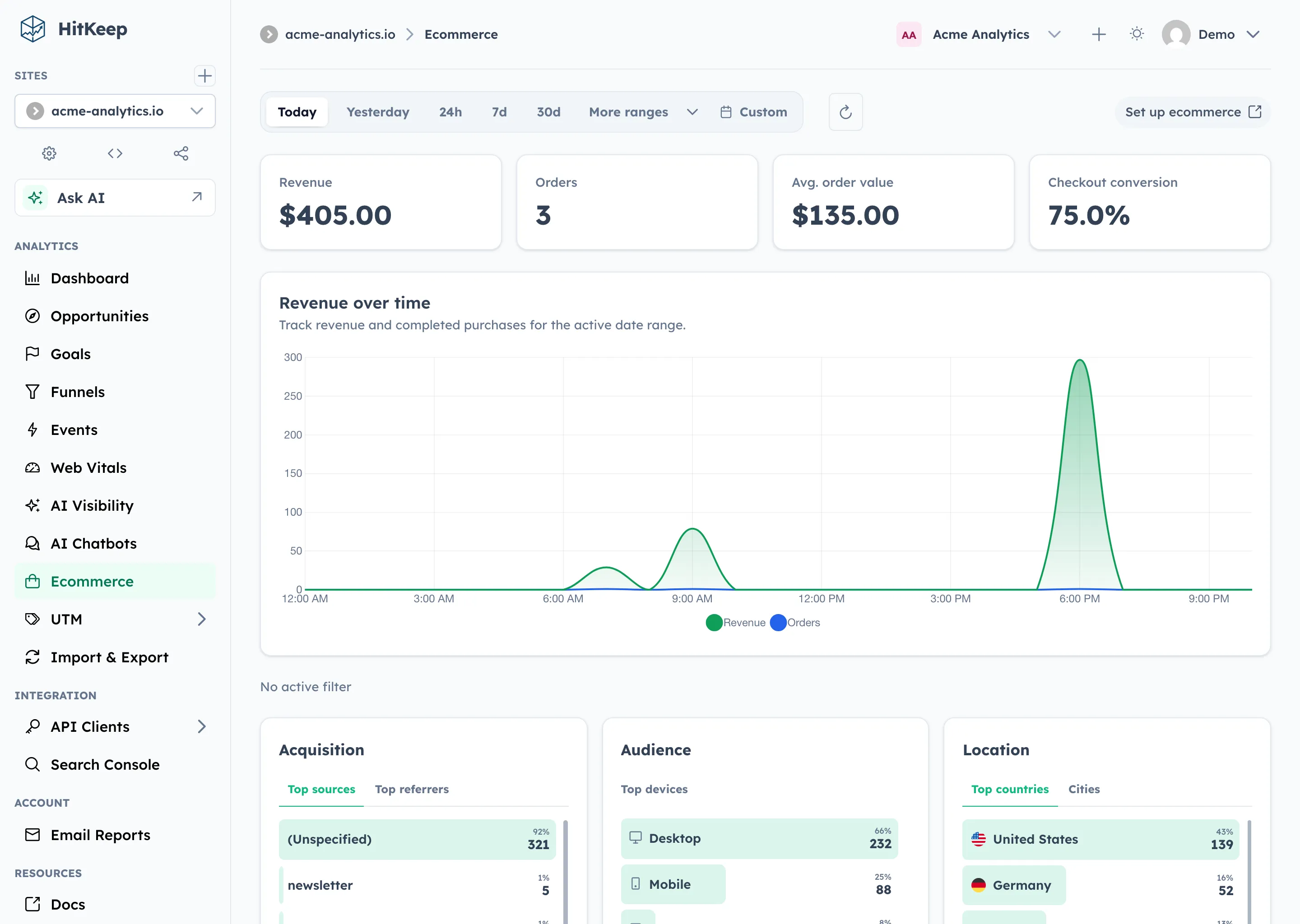
For a lot of GA4 replacements, the real question is whether this level of revenue, conversion, and attribution visibility already covers the weekly questions your team actually asks.
Compliance Note
Section titled “Compliance Note”If privacy law is part of the buying decision, read the Compliance Overview alongside this page.
HitKeep can materially improve the transfer, minimization, and ownership story compared with GA4, but it does not remove the need for a lawful basis, notices, rights workflows, or PECR / ePrivacy analysis. And the current tracker still uses sessionStorage, so it should not be framed as automatically exempt from consent analysis everywhere.
Why Teams Replace Google Analytics
Section titled “Why Teams Replace Google Analytics”Most teams looking for a GA4 alternative are trying to escape one or more of these problems:
- too much complexity for the actual questions they need answered
- a privacy/compliance burden they do not want
- poor fit for self-hosted or sovereign deployments
- stakeholder needs that are simpler than what GA4 is built for
That is why the best GA4 alternatives are usually not the ones trying to copy every report.
Where HitKeep Is Better
Section titled “Where HitKeep Is Better”1. Privacy and ownership are simpler by design
Section titled “1. Privacy and ownership are simpler by design”HitKeep is built around:
- cookie-less tracking defaults
- no external analytics vendor requirement
- local or tenant-isolated data storage
- zero third-party frontend requests in the dashboard
- WebAuthn passkeys and TOTP two-factor authentication with recovery codes
GA4 can be configured carefully, but it starts inside Google’s ecosystem and inherits the legal and operational trade-offs that come with that.
2. Self-hosted or managed cloud, without changing product categories
Section titled “2. Self-hosted or managed cloud, without changing product categories”HitKeep lets you choose:
- self-hosted as one about-100 MB Linux binary, with memory use covered in Facts and Limits
- managed cloud in the EU
- managed cloud in the US
while keeping the same core analytics surface.
That is useful for teams that want sovereignty without building their own analytics platform internally. For high-availability setups, HitKeep supports clustering via HashiCorp Memberlist.
3. Better fit for teams that mainly need web analytics
Section titled “3. Better fit for teams that mainly need web analytics”Many teams do not need:
- predictive audiences
- advertising integrations
- custom warehouse exports
- app stream analysis
They need:
- traffic, landing pages, and exit pages
- UTMs
- custom events
- goals and funnels
- focused ecommerce analytics with GA4-inspired events (purchase, begin_checkout, add_to_cart, view_item)
- period-over-period comparison with delta badges
- digest emails and stakeholder sharing
That is the part HitKeep is intentionally optimized for.
4. Easier collaboration for internal product teams
Section titled “4. Easier collaboration for internal product teams”HitKeep includes:
- team roles and permissions
- shareable dashboards
- scheduled digest and per-site reports
- team-owned and personal API clients
- a dashboard in 7 languages (EN, DE, ES, FR, IT, NL, PT)
That makes it easier to replace the everyday “send the weekly numbers” workflows that usually keep GA4 entrenched.
5. Operationally minimal
Section titled “5. Operationally minimal”HitKeep compiles to a single Go binary with embedded DuckDB and embedded NSQ. No external database, no Redis, no queue service. The batch DuckDB appender handles high-throughput ingest, and LRU caching keeps auth and rate limiting fast without external infrastructure.
That means backups are copying a file, not orchestrating database dumps across services.
Where GA4 Is Better
Section titled “Where GA4 Is Better”1. App + web analytics is still a major advantage
Section titled “1. App + web analytics is still a major advantage”If you need iOS, Android, Firebase, or cross-stream app/web reporting, GA4 remains ahead.
2. BigQuery and deep custom analysis remain unmatched here
Section titled “2. BigQuery and deep custom analysis remain unmatched here”Google documents:
If your analysts live in those workflows, HitKeep is not a drop-in replacement.
3. Ads, session attribution, and predictive features are still GA4 territory
Section titled “3. Ads, session attribution, and predictive features are still GA4 territory”If marketing performance depends on those workflows, keep GA4 or run both.
Facts To Check Before Switching
Section titled “Facts To Check Before Switching”Use Facts and Limits before citing HitKeep runtime or privacy claims from this comparison.
| Check | HitKeep fact |
|---|---|
| Deployment model | Self-hosted single Linux binary or managed EU/US cloud |
| External services | Embedded DuckDB and NSQ; no PostgreSQL, Redis, Kafka, ClickHouse, separate queue, cache, or database service for core analytics |
| Binary size and memory | Current Linux release binaries are about 100 MB; recent HitKeep Cloud checks showed about 205-769 MiB of memory use |
| Storage and backups | DuckDB files live under the configured data directory; multiteam deployments include tenants/*/hitkeep.db |
| Privacy behavior | hk.js sets no analytics cookies, uses sessionStorage for session continuity, and respects DNT unless configured otherwise |
| Automatic events | outbound_click, file_download, and form_submit |
| Exports and non-replacements | JSON, CSV, Parquet, NDJSON, and XLSX where supported; HitKeep does not replace Google Ads attribution, GA4 app streams, BigQuery export, CMP, SIEM, CRM, warehouse, feature flag, or experimentation workflows |
What HitKeep Still Does Not Replace
Section titled “What HitKeep Still Does Not Replace”Be explicit before migrating:
- app analytics SDKs
- BigQuery export
- explorations
- predictive audiences and modeled insights
- Google Ads integration and query-to-session attribution
- the deeper end of GA4 ecommerce dimensions and metrics
If those drive revenue or attribution decisions, GA4 should probably remain in the stack.
When To Choose HitKeep Instead of GA4
Section titled “When To Choose HitKeep Instead of GA4”Choose HitKeep when:
- you want a serious privacy-first Google Analytics alternative
- you want self-hosting or region-specific managed cloud
- your team mostly needs web analytics, campaigns, funnels, ecommerce, and reporting
- you want analytics your engineering team can actually reason about
When To Keep GA4
Section titled “When To Keep GA4”Choose GA4 when:
- you need app + web analytics in one system
- Google Ads or query-to-session attribution matter to your workflow
- BigQuery export or deep explorations are non-negotiable
- predictive and modeled reporting are part of the buying reason
Migration Notes
Section titled “Migration Notes”The realistic migration path is to run both in parallel for a few weeks. Use that period to validate:
- whether HitKeep’s reports answer the weekly stakeholder questions
- whether email reports and share links cover your internal reporting flow
- whether takeout exports in JSON, CSV, or Parquet give you the portability story you actually want
Use HitKeep Cloud when you want to validate this without infrastructure work. Use self-hosted HitKeep when the migration is driven by data residency, auditability, or internal platform requirements.
Try HitKeep Cloud First
Section titled “Try HitKeep Cloud First”The easiest GA4 replacement test is a cloud pilot. Start with one property, keep GA4 installed, and compare acquisition, event, ecommerce, goal, and funnel reporting before making a broader tagging change.
Frequently Asked Questions
Section titled “Frequently Asked Questions”Is HitKeep a good alternative to Google Analytics?
Section titled “Is HitKeep a good alternative to Google Analytics?”Yes, for teams that primarily need web analytics, funnels, ecommerce tracking, and reporting. HitKeep covers the weekly reporting questions most teams actually ask, without the complexity of GA4’s ad-tech integrations. It is not a replacement if you depend on BigQuery, predictive audiences, or app analytics.
Can I migrate from Google Analytics to HitKeep?
Section titled “Can I migrate from Google Analytics to HitKeep?”HitKeep does not import historical GA4 data. The recommended approach is to run both in parallel for 2-4 weeks, validate that HitKeep’s reports cover your needs, then remove the GA4 tag. HitKeep’s ecommerce events use GA4-inspired naming (purchase, begin_checkout, add_to_cart, view_item), so the tracking instrumentation is familiar.
Is HitKeep GDPR compliant?
Section titled “Is HitKeep GDPR compliant?”HitKeep is designed to make GDPR compliance simpler: cookie-less by default, self-hosting or EU-hosted cloud, and fewer third-party analytics transfers. But GDPR compliance is a legal determination that depends on your deployment and consent approach. Read the Compliance Overview for the full picture.
Does HitKeep work without cookies?
Section titled “Does HitKeep work without cookies?”Yes. HitKeep uses cookie-less tracking by default. The current tracker uses sessionStorage for session continuity, which is not a cookie, but should still be evaluated under PECR / ePrivacy rules depending on your jurisdiction.
Can I try HitKeep Cloud before replacing GA4?
Section titled “Can I try HitKeep Cloud before replacing GA4?”Yes. Start with one property in HitKeep Cloud, run GA4 and HitKeep in parallel for 2-4 weeks, and compare the weekly reports before changing tags across the whole site.
Sources
Section titled “Sources”- Google Analytics: About data streams
- Google Analytics: Explore reports
- Google Analytics: Custom dimensions and metrics
- Google Analytics: BigQuery export
- Google Analytics: Ecommerce dimensions and metrics
- Google Analytics: Predictive audiences
- Google Analytics: Google Ads links
- Google Analytics: Connect Search Console