
In 2026, the choice between Google Analytics and privacy-first analytics is no longer just a tooling preference. It determines how consent affects your reporting, where analytics data is processed, how easily you can move it, and whether your measurement stack can distinguish traditional traffic from AI referrals and crawler fetches.
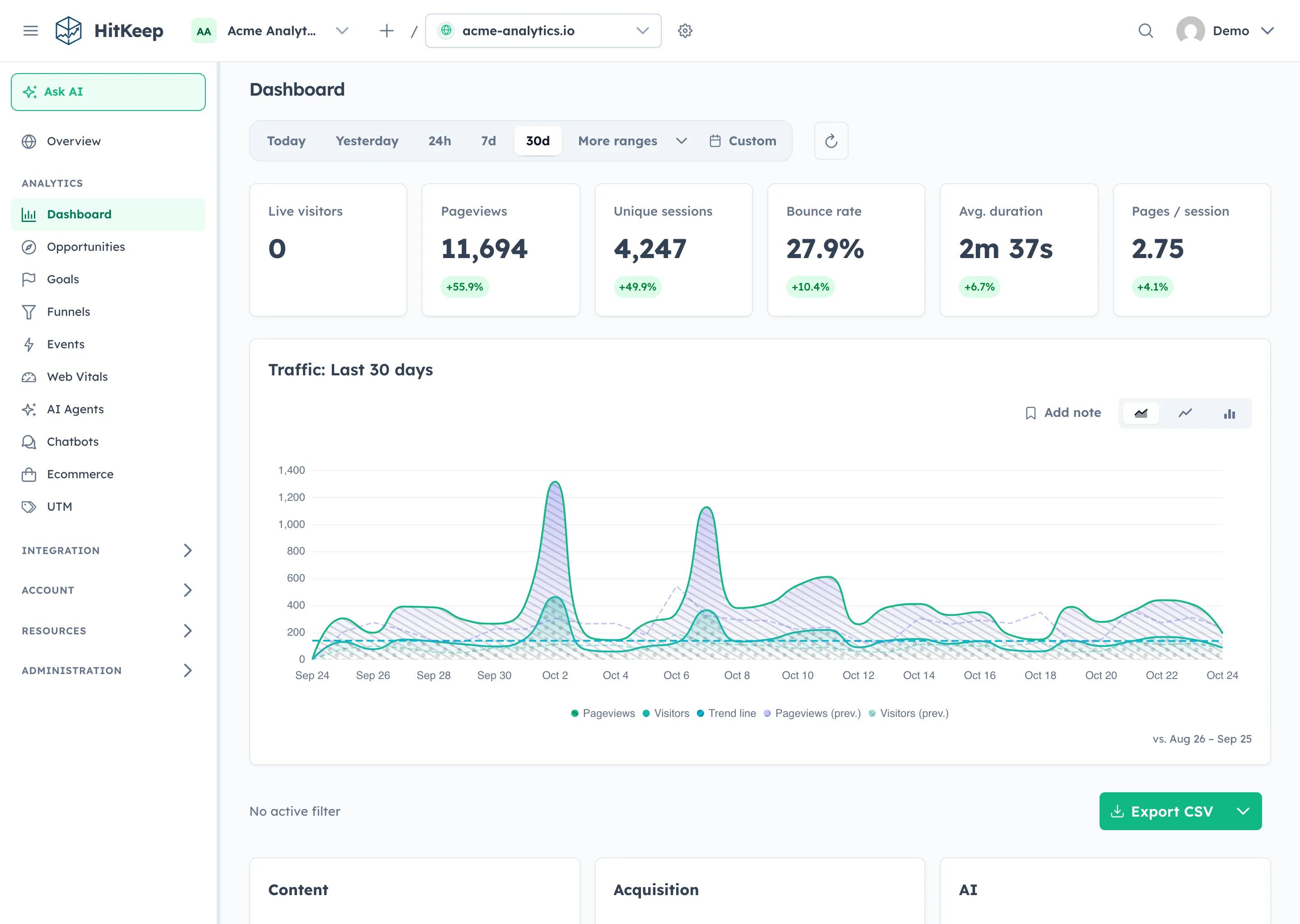
Google Analytics 4 remains powerful, widely understood, and tightly connected to Google Ads. Privacy-first tools have also moved beyond simple pageview counters. Serious products now support goals, funnels, ecommerce events, Search Console data, open exports, AI visibility, and a choice between managed hosting and self-hosting.
The answer does not have to be ideological. For many teams, the practical setup is to use privacy-first analytics as the source of truth for website performance and keep GA4 only where its advertising or advanced analysis workflows add unique value.
If your immediate task is measurement rather than product selection, use the practical guide to checking site traffic without Google Analytics to map visitors, search visibility, server requests, campaigns, and conversions to the right source.
Reviewed July 22, 2026
This article was checked against current Google Analytics, Google Ads, and CNIL guidance. Product behavior and privacy rules change, so re-check the primary sources and obtain advice for your own deployment before making legal or measurement decisions.
The short answer: which approach fits your team?
Choose Google Analytics when Google Ads optimization, remarketing audiences, app analytics, BigQuery workflows, and analyst-grade explorations are central to the job. Choose a privacy-first platform when cookie minimization, a smaller data boundary, operator control, and straightforward website reporting matter more.
| Decision factor | Google Analytics 4 | Privacy-first analytics |
|---|---|---|
| Best fit | Ad-heavy teams, app and web analytics, Google Ads optimization, and established analyst workflows | Privacy-conscious teams, publishers, SaaS companies, agencies, public-sector organizations, and teams focused on first-party website outcomes |
| Default web tracking | GA4’s JavaScript tag uses first-party cookies to distinguish users and sessions; Consent Mode can alter tag and storage behavior | Varies by product; often designed to avoid analytics cookies or persistent identifiers by default |
| Data control | Reports live in Google’s product, with raw-event export available through BigQuery | May offer self-hosting, regional hosting, open exports, and direct control over retention and infrastructure |
| Compliance work | Requires purpose, consent, configuration, data-sharing, and transfer review | Can reduce the data boundary, but still requires review of the complete implementation and jurisdiction |
| AI traffic | AI referrals can appear through normal acquisition data; crawler fetches require server-side evidence | Some products separate AI referrals, crawler fetches, and completed outcomes as dedicated reports |
| Ecosystem | Strongest with Google Ads, BigQuery, Looker Studio, Firebase, and Google integrations | Strongest when transparency, portability, and independence are priorities |
For a product-by-product feature matrix, use the HitKeep vs Google Analytics comparison. This article stays at the strategy level: what each analytics model is good at, where the evidence differs, and how to choose a source of truth.
What changed by 2026?
Four changes have moved analytics architecture beyond the marketing team.
First, privacy and ePrivacy review now affects tracking design in Europe and many other jurisdictions. The useful question is not whether a vendor uses the word “privacy.” It is what the tracker stores, where the data goes, how it is combined, how long it is retained, and which controls the operator can enforce.
Second, consent choices affect measurement. In basic Consent Mode, Google tags remain blocked until consent and send no data when consent is denied. In advanced Consent Mode, tags can send cookieless pings while storage is denied, and Google may use those signals for modeling when its thresholds are met. Those modes produce different evidence, and modeled outcomes are not interchangeable with directly observed events.
Third, AI has changed discovery. A rendered visit, an AI-referred click, a remote crawler fetch, and a completed signup answer four different questions. A dashboard that combines them into one “AI traffic” number hides the collection boundary.
Finally, more organizations want to know whether analytics can move with them. Data location, export formats, deletion, retention, and self-hosting now appear in procurement and platform reviews, not just analytics implementation tickets.
Where Google Analytics is still strong
GA4 is especially strong when revenue operations depend on Google Ads. Linking a GA4 property to Google Ads supports audience sharing, site statistics in Ads, and advertising reporting inside Analytics. For teams optimizing substantial paid budgets, that integration can justify keeping GA4 even when another platform becomes the primary website dashboard.
Google also has a broad talent and tooling ecosystem. Agencies and analysts understand GA4 concepts, and the surrounding stack includes BigQuery, Looker Studio, Firebase, tag management, and third-party connectors.
GA4’s event model is flexible. Page loads, clicks, scrolls, purchases, and custom interactions can be represented as events with parameters. BigQuery Export adds a raw-event analysis path for teams that need SQL access, and Google states that customers own the data exported into their BigQuery project.
Those strengths come with operational and governance choices. The standard web tag uses the _ga and _ga_<container-id> first-party cookies by default. Consent Mode is a separate integration with a consent banner or platform; it does not provide consent by itself. GA4 also remains a proprietary service rather than infrastructure an operator can run or inspect end to end.
What privacy-first analytics means in 2026
Privacy-first analytics is a category, not one architecture. The useful definition is a measurement system that deliberately minimizes collection and keeps the data boundary proportionate to the business questions being asked.
A privacy-first platform commonly emphasizes some combination of:
- cookie-free or minimized tracking by default;
- fewer persistent identifiers and less cross-site or cross-product combination;
- explicit retention, export, and deletion controls;
- regional managed hosting or self-hosting;
- transparent collection behavior; and
- separate evidence for human visits, bots, AI crawlers, and conversions.
The goal is not to collect nothing. Teams still need to know which campaigns work, which pages generate qualified demand, where funnels lose users, and whether search visibility produces business outcomes. The difference is starting with the minimum evidence needed for those decisions instead of building the largest possible visitor profile.
France’s CNIL describes circumstances in which certain audience-measurement trackers can be exempt from consent, but only under strict conditions such as publisher-only measurement, anonymous statistics, no cross-site tracking, and no combination with other processing. That guidance is France-specific and does not make every cookie-free or privacy-first implementation exempt elsewhere.
Google Analytics vs privacy-first analytics: the real comparison
A useful comparison starts with the recurring decisions your team needs to make:
- Which channels produce qualified visits and conversions?
- Which pages support acquisition or activation?
- Are technical SEO changes improving clicks and outcomes?
- Did a change in consent or tagging alter the report?
- Are AI assistants sending visits or only fetching content?
- Can we export the evidence and recompute the result ourselves?
| Area | Google Analytics | Privacy-first analytics |
|---|---|---|
| Traffic measurement | Broad and configurable, with results affected by tag behavior, consent implementation, browser limits, blockers, and reporting configuration | Often narrower and easier to audit, but still affected by blockers, network failures, filtering, and the product’s own session model |
| Conversion tracking | Strong for Google Ads, app events, cross-channel attribution, and audience workflows | Strong when goals and funnels map directly to first-party business outcomes |
| User identification | Supports advanced identity, audience, and attribution workflows when configured and permitted | Usually avoids or limits persistent personal identifiers |
| Compliance posture | Requires careful review of collection, consent signals, Ads linkage, sharing, retention, and transfers | Can reduce exposure through minimization and operator control, but is not automatically compliant |
| Data portability | BigQuery can export raw GA4 events into a customer-controlled project, subject to setup and limits | Often prioritizes downloadable open formats, APIs, and complete operator-controlled takeout |
| Operational complexity | Can involve tags, Consent Mode, events, custom definitions, audiences, modeled outcomes, and linked products | Often aims for fewer moving parts, though self-hosting adds backup, security, and upgrade responsibilities |
| AI-era reporting | Records rendered visits and recognizable referrals; non-rendered crawler fetches need edge or origin evidence | Some platforms make AI referrals and crawler fetches first-class but must still keep them separate |
The distinction is one of optimization. GA4 is deeply optimized for Google’s advertising, app, and analysis ecosystem. Privacy-first analytics is usually optimized for first-party website measurement, a smaller collection boundary, and operator control.
Compliance: neither label decides the outcome
“Google Analytics is illegal” and “privacy-first analytics is compliant” are both poor decision rules.
GA4 can be deployed with consent management, storage controls, retention settings, and restricted Ads use. Whether that deployment is lawful depends on its purpose, configuration, contracts, transfers, notices, and jurisdiction.
A privacy-first platform can also be deployed badly. Combining analytics with identifiable CRM data, retaining detailed logs indefinitely, or adding fingerprinting defeats the point of minimized tracking. Cookie-free does not mean regulation-free, and browser storage such as sessionStorage may still require ePrivacy or PECR analysis.
Ask concrete questions instead:
| Question | Why it matters |
|---|---|
| What does the tracker read or write on the device? | Cookies, local storage, session storage, and fingerprinting can trigger different technical and legal review. |
| Which identifiers and event properties leave the browser? | This defines the actual data boundary rather than the marketing label. |
| Where is the data stored and processed? | Residency and transfers can affect procurement and legal obligations. |
| Can data be combined with advertising, CRM, or cross-site profiles? | Combination changes both utility and risk. |
| Can operators configure retention, export, and deletion? | These controls determine portability and lifecycle management. |
| Which metrics are observed and which are modeled? | Teams need to know what kind of evidence supports a decision. |
HitKeep’s privacy-first analytics overview describes its collection boundary and the consent caveats without making a universal compliance claim.
Data ownership and control
“Ownership” is too vague unless it is broken into concrete controls.
GA4 reports live inside Google’s proprietary platform. BigQuery Export creates a copy of raw GA4 event data in a customer-controlled Google Cloud project, where Google says the customer owns the exported data and manages dataset permissions. That is a meaningful portability path, but it still depends on configuring another Google Cloud service and does not make GA4 self-hosted software.
Privacy-first products often compete on a different set of controls: direct file exports, APIs, configurable retention, region selection, or a self-hosted runtime. Open-source software also lets teams inspect how collection and storage work rather than relying only on vendor documentation.
HitKeep supports managed EU or US deployment and self-hosting from the same open-source foundation. The self-hosted product runs as one Go binary with DuckDB and NSQ embedded. Current runtime and collection details belong in Facts and Limits, while the available export surfaces and portability boundaries are documented in data takeout.
Self-hosting is not automatically the better choice. It transfers upgrades, backups, monitoring, access control, TLS, and incident response to your team. Use the self-hosted GA4 alternative guide when infrastructure control is the reason for evaluating a switch; use HitKeep Cloud pricing when the goal is to test the reporting model without owning those operations.
Reporting quality: compare definitions before totals
More sophistication does not guarantee a more useful number. Accuracy depends on the question and on whether both tools define the metric the same way.
GA4 can be the better source for Google Ads optimization, app and web identity, modeled key events, and warehouse analysis. A focused privacy-first dashboard can be easier to trust for pageviews, referrers, goals, and funnels when the team can inspect the collection rules and does not need advertising audiences.
Do not expect two tools to produce identical sessions or users. They can differ because of consent state, blockers, cookie or storage rules, session timeouts, bot filtering, geography enrichment, late events, and attribution models. Validate business outcomes—accepted leads, created accounts, confirmed purchases—before debating small traffic differences.
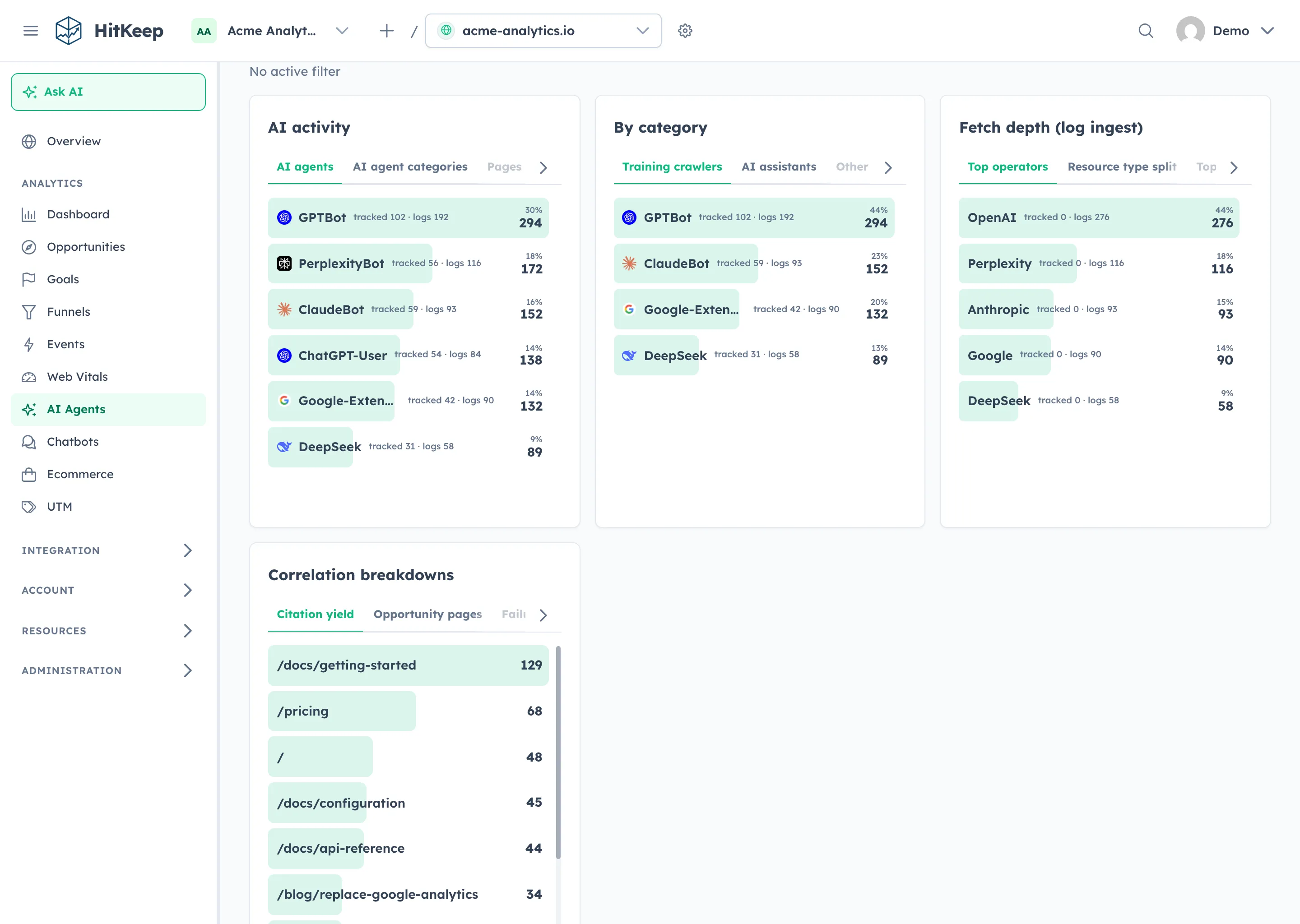
Search performance belongs beside website analytics but remains a distinct dataset. HitKeep’s Google Search Console integration imports finalized aggregate query, page, country, and device rows; it does not connect a query to an individual session.
AI traffic changes the comparison
AI search, assistants, and browsers create measurement paths that traditional session reports do not fully explain.
- A rendered page can execute browser analytics.
- A click from an assistant can arrive with a recognizable referrer.
- A remote crawler fetch can appear in edge, CDN, proxy, or origin logs without executing JavaScript.
- An answer generated without a new request to your site leaves no direct pageview.
- A completed signup or purchase is best confirmed by the backend that accepted it.
GA4 can record rendered visits and some AI referrals when its tag runs and the referrer is available. Non-rendered crawler retrieval requires server-side evidence regardless of the browser analytics product.
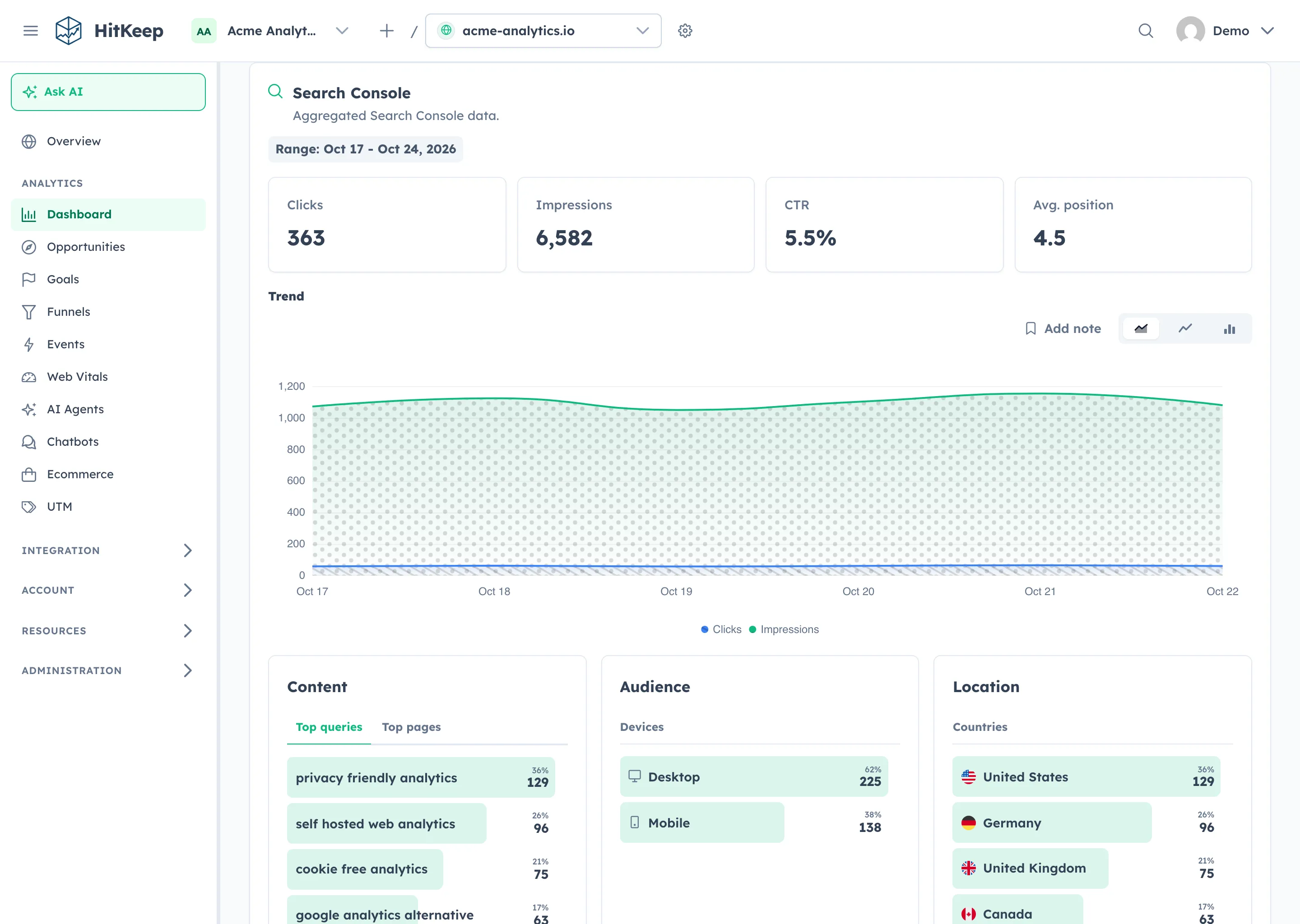
HitKeep’s AI Visibility report keeps AI-referred visits and forwarded crawler fetches separate. Neither signal proves that an assistant cited a page or influenced a later direct visit. The AI browser tracking guide explains the boundary in more detail.
When to keep Google Analytics
Keep GA4 when it directly supports revenue or analysis workflows that another platform does not replace:
- Google Ads attribution and audience activation;
- app and web analytics in one property;
- BigQuery-first analysis;
- Explorations, custom dimensions, and predictive workflows;
- agency or stakeholder processes that depend on GA4 output; or
- an implementation that has already passed your legal and security review.
Keeping GA4 does not require making it the source of truth for every audience. A hybrid model can reserve GA4 for advertising and advanced analysis while a privacy-first platform handles website performance, SEO, content, and executive reporting.
When to switch to privacy-first analytics
Make privacy-first analytics the primary platform when your organization wants to minimize identifiers, narrow third-party data sharing, choose a hosting region, self-host, or simplify reports around first-party outcomes.
The approach is often a good fit for B2B SaaS companies, publishers, agencies, open-source projects, nonprofits, public-sector organizations, and teams whose website analytics questions do not require advertising-grade user profiles.
Privacy should not mean giving up business measurement. Look for goals, funnels, campaign and UTM reporting, ecommerce events, Search Console data, exports, APIs, retention controls, and a documented distinction between human visits and bot or AI activity.
A practical migration path
Run both systems in parallel before changing the reporting contract.
- Audit the current GA4 property. Identify the events, key events, audiences, reports, BigQuery jobs, and Ads links that people actually use.
- Separate advertising from business reporting. Mark which workflows exist for Google Ads and which answer broader acquisition, content, conversion, and executive questions.
- Map the privacy requirements. Review collection, consent, storage, residency, retention, vendor access, and export needs with the responsible stakeholders.
- Install privacy-first analytics beside GA4. Run both for at least one complete business cycle without treating raw session totals as a pass/fail test.
- Align outcome definitions. Make sure “lead,” “signup,” “purchase,” and funnel steps mean the same thing, and prefer backend-confirmed events for critical outcomes.
- Choose a source of truth per job. Keep GA4 where its Ads, app, or warehouse integrations are unique; use the privacy-first platform where it provides clearer and more controllable website reporting.
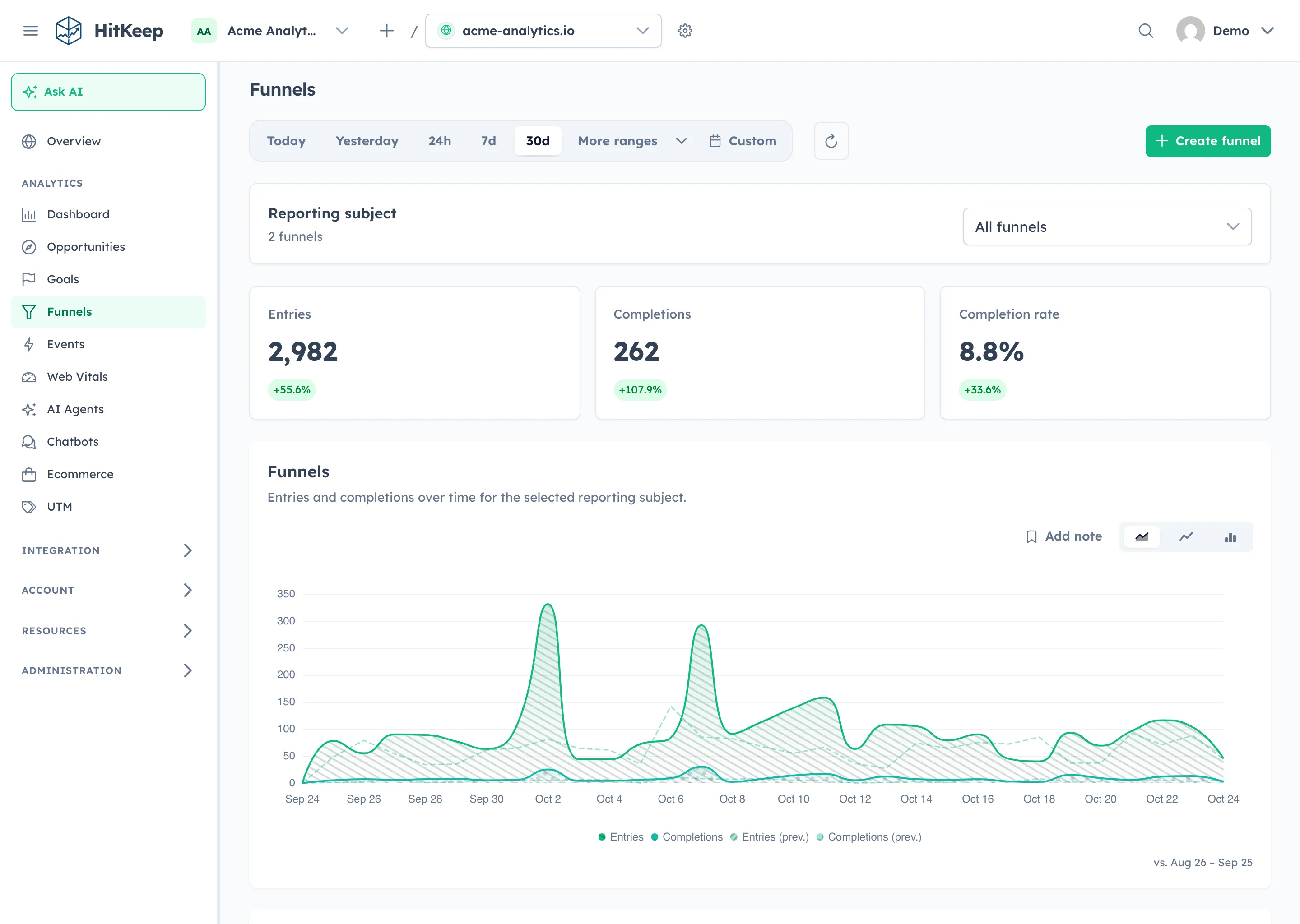
This process prevents the most common migration error: comparing two tools before agreeing on what the business actually needs to measure.
Final verdict
Google Analytics remains a strong choice in 2026 for teams invested in Google Ads, app analytics, BigQuery, and advanced attribution workflows. It is no longer the automatic answer for every website.
Privacy-first analytics is a serious alternative when the primary job is understanding first-party website traffic and outcomes with a smaller data boundary and more operator control. It can also sit beside GA4 rather than replacing it immediately.
Use Google Analytics where its ecosystem is uniquely valuable. Make privacy-first analytics the center of gravity when the reports need to be understandable, portable, and proportionate to the decisions your team is making.