
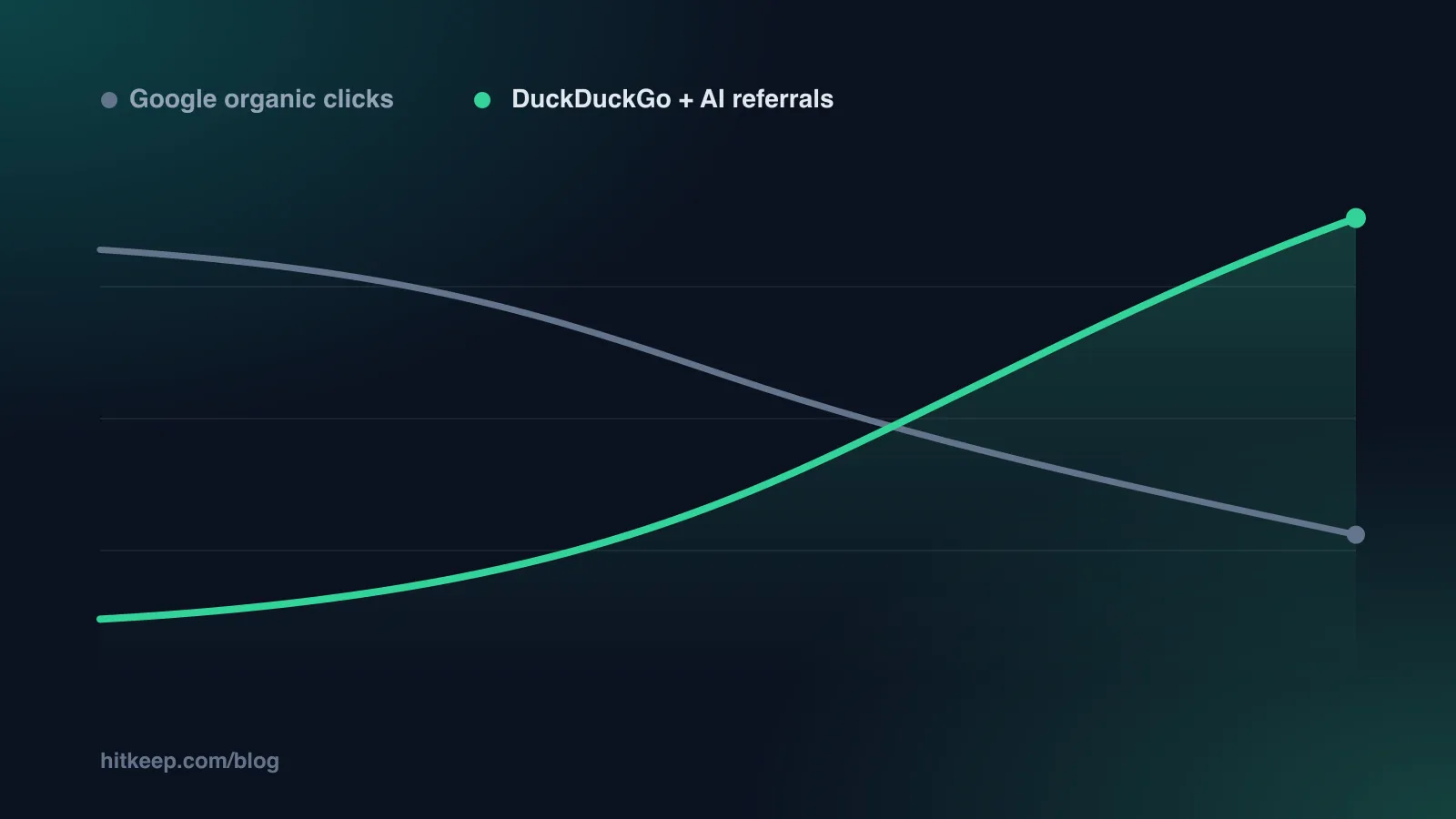
Your search traffic chart changed shape this spring, and the usual explanations do not cover it. Google is rolling out an AI-first search experience, a visible share of users is protesting by moving to no-AI alternatives, and AI Overviews answer queries before anyone clicks a result. All three shifts land in the same place: the referral data reaching your site.
This post covers what is actually happening, with the numbers from the reporting, and shows how to detect the shift in your own analytics instead of guessing.
Users are moving to DuckDuckGo and no-AI search
The pattern is consistent across multiple outlets. TechCrunch reported that “DuckDuckGo noted a 30% increase in web visits to its no-AI search page week-over-week,” alongside new Chrome and Firefox extensions that make the no-AI experience a default. The Independent reported that DuckDuckGo app installs rose by nearly a third after Google’s AI updates, quoting CEO Gabriel Weinberg: “Google is force-feeding AI with no way to opt out.”
Gizmodo tied the growth to user frustration with AI-generated answers and declining result quality. Wide Open Country cited Pubity data putting DuckDuckGo’s traffic increase at 300% since Google’s changes, and noted a parallel rise in the Vivaldi browser.
Keep the scale honest: per Statcounter, DuckDuckGo holds roughly 0.7% global market share against Google’s 90%+. Nobody is dethroning Google this quarter. Acquisition analysis cares about your referral mix rather than global market share, though, and a few percentage points moving between engines is enough to break attribution assumptions and weekly dashboards.
AI Overviews reduce clicks to source sites
The second shift is structural. When Google answers a query inline with an AI Overview, the click to the source page often never happens. ExtremeTech called the AI-first model potentially “disastrous for both the company and the broader internet ecosystem” precisely because it starves source sites of visits.
The trust dimension makes it worse. A BBC investigation showed how easily AI answers can be manipulated, quoting SEO expert Lily Ray: “You should assume that you’re being manipulated until they have better systems in place.” The same reporting notes that 2.5 billion people see Google’s AI Overviews each month. Broad exposure plus visible skepticism drives users to test alternatives, and it should drive publishers to recheck their numbers.
Check your own referral mix first
Before changing strategy, measure. If you have raw analytics data, the first check takes minutes. With a HitKeep Parquet export, it is one DuckDB query:
-- Referral mix by search engine, week over weekSELECT date_trunc('week', timestamp) AS week, CASE WHEN referrer ILIKE '%google%' THEN 'google' WHEN referrer ILIKE '%duckduckgo%' THEN 'duckduckgo' WHEN referrer ILIKE '%bing%' THEN 'bing' WHEN referrer = '' THEN 'direct' ELSE 'other' END AS source, count(*) AS pageviewsFROM 'pageviews.parquet'GROUP BY 1, 2ORDER BY 1 DESC, 3 DESC;You are looking for three symptoms:
- Google share falling while direct or other engines rise. That is a signal of a possible channel shift, not proof that users migrated. Investigate campaign changes, tracking gaps, and affected landing pages before attributing the cause.
- Search Console impressions flat or rising while clicks fall. That is consistent with more zero-click results, including AI Overviews, but it does not identify the cause by itself. Check affected queries and the search-result layout before attributing the change.
- Stable sessions but worse downstream conversion from organic. That points to a change in channel quality rather than lost acquisition, and the two problems need different fixes.
In the dashboard, period-over-period comparison against the weeks before Google’s rollout gives you the same answer without exporting anything.
Instrument funnels and events
A total-sessions chart hides structural change. To tell an acquisition drop apart from a channel-mix shift, you need event-level visibility:
- Custom events for signup steps, key outbound clicks, and downloads, so conversion is measured independently of pageviews.
- Funnels segmented by referrer, so you can see whether DuckDuckGo arrivals reach step two of onboarding at a different rate than Google arrivals.
- UTM reporting for the channels you control, so paid and owned traffic does not blur the organic picture.
- Bot and spam filtering at collection time. Bot traffic masquerades as referral shifts, and a small real change in channel mix can look much bigger than it is when bots skew the data.
None of this requires analytics cookies. HitKeep records referrers and events with cookie-less tracking by default. Your consent and legal-basis analysis still depends on the full site configuration and jurisdiction. That matters here because the same backlash pushing users toward DuckDuckGo is privacy sentiment. Collecting more data than the analysis needs would be the wrong response.
Track AI assistants as their own channel
Search engines are only half of the new referral landscape. ChatGPT, Perplexity, and Claude cite and link sources, and their crawlers fetch your pages before any human visit shows up. The BBC’s reporting notes more than a billion people use AI chatbots regularly. That audience never appears in a classic search report.
HitKeep treats this as its own reporting surface: AI visibility analytics separates AI referral traffic from search referrals, and AI fetch ingest records GPTBot, ClaudeBot, and PerplexityBot fetches from your edge or origin logs.
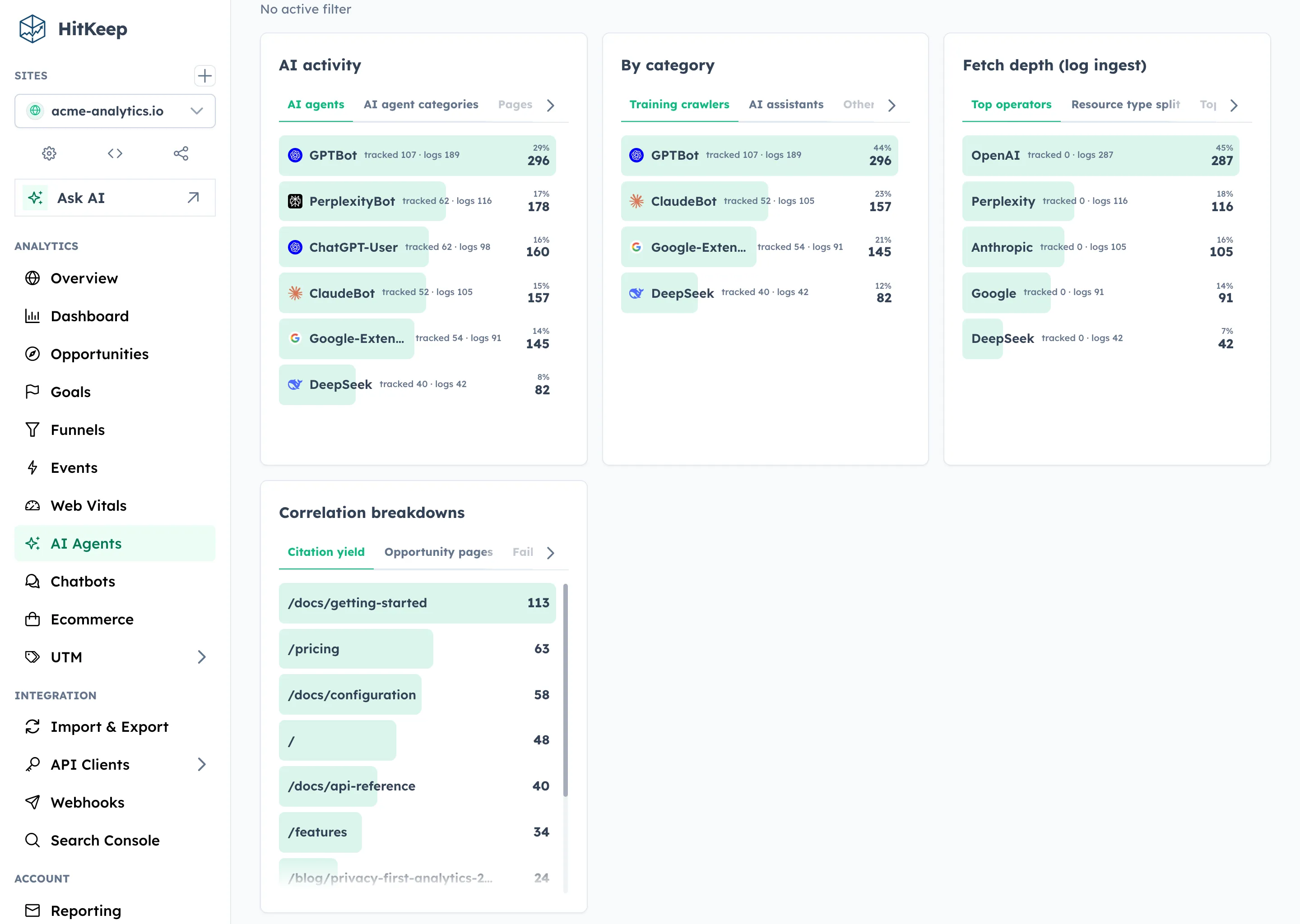
If Google’s AI answers may be taking clicks, seeing which systems fetch your content and which assistants later send referred visits adds useful context. Those are separate signals; neither one proves that a page was cited in an AI answer.
Run the measurement stack you can trust
When the search layer changes overnight, the analytics layer has to be something you can inspect and rely on. HitKeep is built for that case: a single Go binary with embedded DuckDB and NSQ, so there is no external database, cache, or queue to operate. Retention is configurable to your compliance constraints, and open exports in JSON, CSV, and Parquet support ad-hoc analysis like the query above. The self-hosted GA4 alternative guide covers the setup. One fair caveat from it: if your business depends on Google Ads attribution or BigQuery exports, a Google-native stack may remain essential.
If you want the same measurement without running infrastructure, HitKeep Cloud uses HitKeep’s shared open-source analytics foundation in region-pinned EU (Frankfurt) or US (Virginia) infrastructure with managed updates and backups. That helps when the team that needs these answers this week has no time to operate another service.